AI for e-commerce · July 18, 2026 · 9 min read
AI personalization in e-commerce: examples and a practical rollout


Personalization often starts with an ambitious promise: every shopper sees the perfect store. In practice, the useful version is narrower. A returning customer gets a relevant replenishment reminder. A product row reflects the category they are browsing. Search recognizes their context without hiding the rest of the catalog.
The smaller version is easier to measure, easier to explain, and less likely to become creepy.
AI personalization in e-commerce uses customer, catalog, and contextual signals to rank or adapt products, content, search results, messages, and assistance for a shopper or segment. Begin with one high-intent surface, use only necessary consented data, compare it with a control, protect exploration and customer choice, and measure incremental conversion, margin, returns, and trust—not clicks alone.
Quick take
- Personalization is a ranking decision: it changes what appears, in which order, for whom, and why.
- One surface is enough to start: a recommendation row or lifecycle email can prove value without rebuilding the storefront.
- Behavior is not intent: a gift search, shared device, or accidental click can mislead a model.
- Use a holdout: before-and-after results confuse personalization with seasonality, campaigns, and traffic changes.
- Protect trust: consent, data minimization, explanations, and easy resets matter alongside conversion.

What is AI personalization in e-commerce?
AI personalization uses models to decide which item, message, offer, or experience is most relevant for a shopper or segment. Inputs can include current session behavior, prior purchases, search terms, channel, device, geography, stock, price, and product relationships.
Traditional personalization usually follows rules written by a marketer: “If a customer bought coffee, show filters after 21 days.” AI can learn patterns from data and update rankings as behavior changes. The rule is easier to explain; the model can account for more interactions. Many useful systems combine both.
Shopify's July 2026 guide to AI personalization in e-commerce highlights five active applications: recommendations, homepage experiences, email, advertising, and shopping assistants. The timing is a useful demand signal, but merchants should still test what works for their own catalog and customers.
Where can an online store use AI personalization?
Product recommendations
Rank products using the current item, cart, browsing sequence, purchase history, and patterns from similar shoppers. This can support “complete the set,” alternatives, replenishment, or discovery. Our AI product recommendation guide focuses specifically on conversational recommendations; personalization is the wider system across surfaces.
Search and category ranking
Two shoppers can use the same words but prefer different brands, sizes, or price ranges. Personal context can rerank otherwise relevant results. Always keep hard constraints—compatibility, size, stock, safety—above predicted preference. Semantic search solves meaning; personalization adjusts ranking within what meaning and constraints allow.
Homepage and landing content
A returning visitor might see the category they previously explored, while a first-time visitor sees the store's broad proposition. Start with a module, not an entirely different homepage. Large changes make attribution and QA difficult.
Email and lifecycle messaging
AI can help build granular segments, select products, or optimize timing. The message still needs a lawful audience, an accurate offer, frequency limits, and a clear reason for being sent. “Likely to buy” does not override consent or suppression rules.
Offers and incentives
Personalized incentives can protect margin by avoiding a blanket discount, but they can also appear unfair. Do not infer willingness to pay from sensitive traits or quietly charge different customers different base prices. Prefer transparent eligibility such as loyalty status, replenishment timing, or a published bundle rule.
Conversational shopping
An assistant can ask what the shopper needs and personalize from answers given in the conversation. This “declared preference” can be more reliable and less invasive than guessing from a long behavioral profile. The assistant should state why it recommends an item and allow the shopper to change constraints.
What data does personalization need?
Use the minimum data that makes the chosen surface better.
| Signal | Useful for | Common trap |
|---|---|---|
| Current query and page | Immediate intent | Overreacting to one click |
| Cart contents | Compatibility and complements | Pushing unnecessary add-ons |
| Purchase history | Replenishment and lifecycle | Treating gifts as personal preference |
| Product attributes | Relevant ranking | Missing or inconsistent fields |
| Stock and margin | Feasible recommendations | Hiding the best customer match for margin |
| Channel and campaign | Landing-page context | Assuming source reveals identity |
| Profile or loyalty status | Known preferences and benefits | Collecting more than the use case needs |
Anonymous session context is enough for many early tests. A shopper looking at trail shoes does not need a persistent identity for the store to show compatible socks. Persistent cross-session profiles require stronger notice, controls, retention, and lawful processing.
How does an AI personalization system make a decision?
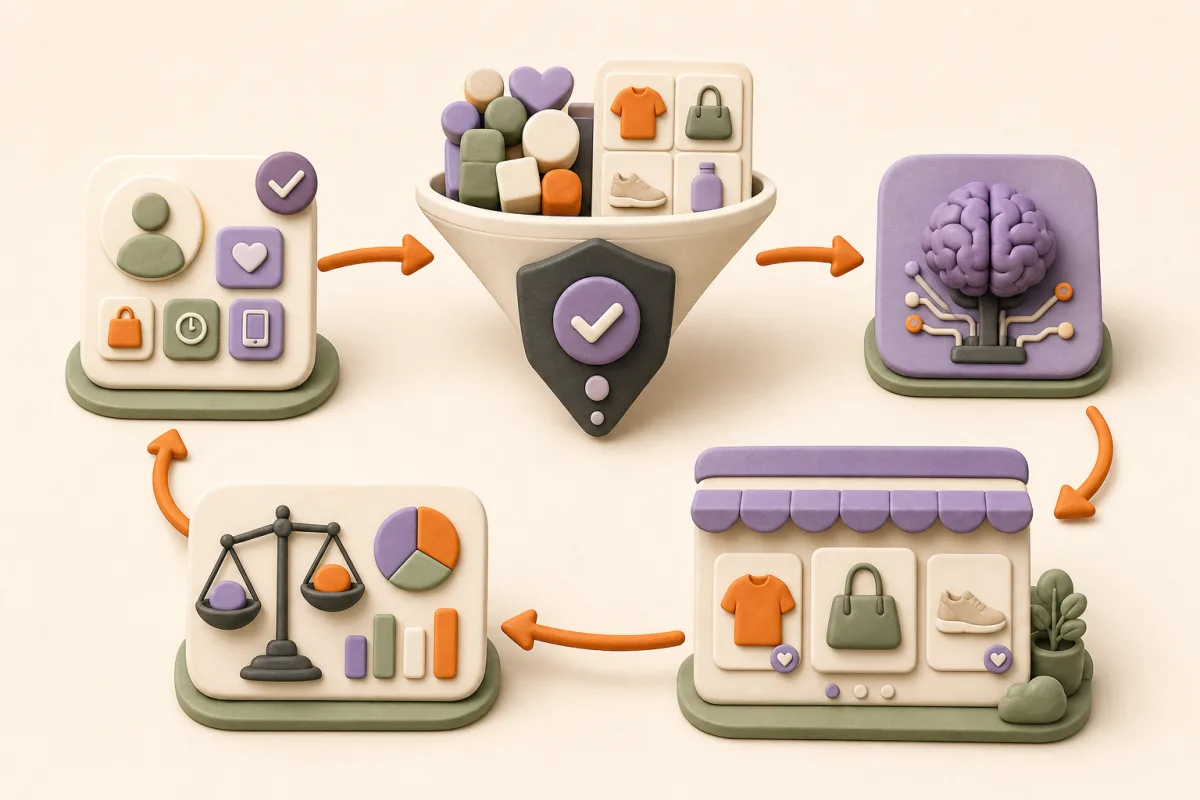
A practical system has five layers:
- Context: permitted session, customer, catalog, and business signals.
- Eligibility: stock, compatibility, geography, consent, frequency, and policy rules.
- Ranking: a model scores the eligible products or messages for the current objective.
- Presentation: the store renders a recommendation row, search order, email, or conversational suggestion.
- Learning: experiments and outcomes show whether the change helped.
Eligibility belongs before ranking. A high predicted click score should never make an out-of-stock, incompatible, age-restricted, or unavailable item eligible.
How should a small store start personalizing?
Choose a moment with clear intent and enough traffic:
- complementary products on a product page;
- a replenishment email for a repeat-purchase category;
- a “continue exploring” module for returning visitors;
- reranking for a high-volume search query;
- a shopping assistant that asks two or three preference questions.
Then write a hypothesis: “For returning customers who bought this consumable 25–40 days ago, a reminder with the same SKU and one alternative will improve repeat purchase without increasing unsubscribes.”
Define the control, primary outcome, guardrails, and duration before launch. Do not add five personalized surfaces at once; you will not know which one caused the result.
How do you measure personalization correctly?
The key word is incremental. You want to know what happened because of personalization, not merely what personalized shoppers did.
Use a randomized holdout where possible. Track:
- conversion or revenue per eligible session;
- contribution margin, not only order value;
- product diversity and discovery;
- returns and cancellations;
- email unsubscribes and notification fatigue;
- page speed and interaction stability;
- complaints, opt-outs, and preference resets.
Recommendation clicks are diagnostic, not the final goal. A system can generate many clicks by making the row prominent or provocative while adding no orders.
Watch longer-term behavior too. Repeatedly showing what the model already knows can trap shoppers in a narrow category and make new products invisible. Reserve some space for exploration, editorial priorities, and customer-controlled browsing.
What privacy rules apply to AI personalization?
Personalization can involve personal data and profiling. The European Data Protection Board's guidance remains an important reference for GDPR-related profiling and automated decisions.
Practical controls include:
- identify a lawful basis for each use;
- explain the categories of data and purpose clearly;
- collect no more than the surface requires;
- respect consent and channel preferences;
- set retention periods and access controls;
- let people opt out or reset recommendations;
- assess whether a decision has legal or similarly significant effects;
- avoid inferring sensitive characteristics unless there is a valid, explicit basis and strong need.
Personalized product ordering is usually lower risk than automated credit, employment, or insurance decisions, but “lower risk” is not “no obligations.” Get appropriate legal advice for your markets and use cases.
What can go wrong with AI personalization?
Common failure modes include:
- false intent: a shopper researches a gift and the store remembers it forever;
- cold start: new visitors and products lack history;
- feedback loops: popular products receive exposure, causing more popularity;
- margin capture: the system prioritizes profitable products over suitable ones;
- filter bubbles: repeat shoppers stop discovering the catalog;
- creepiness: the experience reveals that the store knows more than expected;
- identity errors: shared devices or merged profiles mix people;
- hidden performance cost: extra scripts slow the page enough to erase conversion gains.
Use contextual signals, explicit preferences, diversity rules, limits on persistence, and regular human merchandising review. Personalization should make the store feel helpful, not predetermined.
Frequently asked questions
What is an example of AI personalization in e-commerce?
A returning customer who bought a 30-day supply sees a timely replenishment module with the same product and one suitable alternative. The store uses purchase timing, current availability, and consented context, then compares the module with a holdout group to measure incremental repeat purchases and unsubscribes.
How is AI personalization different from recommendations?
Recommendations are one personalized surface: a ranked set of products. AI personalization is broader and can adapt search order, homepage modules, email timing, customer segments, offers, advertising, and conversational assistance. A recommendation engine may be part of the system, but it does not define the whole strategy.
Can small stores use AI personalization?
Yes. Start with a single surface that has clear intent and enough eligible traffic, such as complementary products or replenishment email. Session context and simple purchase history may be sufficient. Small stores should avoid expensive, site-wide personalization until a controlled test proves incremental value.
Does personalization require third-party cookies?
No. Many useful experiences can use first-party session context, declared preferences, current cart contents, or consented customer history. The appropriate setup depends on jurisdiction, channel, and purpose. Minimize data, explain the use, respect preferences, and avoid adding cross-site tracking merely because a tool supports it.
How do I know if personalization is working?
Use a control or holdout and compare incremental conversion, revenue, contribution margin, returns, and trust guardrails among eligible users. Clicks on a recommendation or email are supporting signals. Predefine the test duration and avoid changing several personalized surfaces during the same experiment.
Can AI personalization feel creepy?
Yes, especially when it exposes unexpected knowledge, follows a one-off behavior for too long, or removes customer control. Prefer immediate context and declared preferences, explain useful personalization, provide opt-outs or resets, cap frequency, and avoid sensitive inferences. Relevance should be understandable rather than uncanny.
What data should I avoid using for personalization?
Avoid data that is unnecessary, unreliable, obtained without a valid basis, or likely to create harmful sensitive inferences. Be particularly cautious with health, ethnicity, religion, sexuality, children, precise location, financial vulnerability, and data bought from opaque sources. Legal obligations vary, so assess the actual market and decision.