Vendor comparisons · July 3, 2026 · 17 min read
The 10 best chatbot platforms in 2026 (with real screenshots)


Search for "best chatbot platforms" and you'll find twenty near-identical lists, most of them ranked by affiliate payout rather than merit. This one is different in two ways: every screenshot below is a real capture of the vendor's product page from July 2026 (not a stock illustration), and we'll tell you plainly when a platform is a bad fit — including our own, which sits at #6, not #1.
If you are deciding whether a new 2026 release changes the shortlist at all, our dated AI chatbot developments review separates deployable voice, commerce, and agent features from infrastructure announcements.
One honest note before we start: "best" depends entirely on what you're building. A five-person Shopify store, a 200-agent enterprise support org, and an agency building bots for clients need three completely different tools. So instead of pretending there's one winner, each section ends with a clear "Best for:" line — find yours and skip the rest.
There's no single best platform — it depends on your size and use case. Zendesk AI or Intercom Fin lead for enterprise, Gorgias for established e-commerce teams, Tidio for small-business DIY, and Voiceflow or Chatbase for builders. Loqara (our product) fits stores wanting grounded chat and voice without a full helpdesk. Avoid starting anything new on Drift — it's sunsetting.
Quick take
- Enterprise support orgs: Zendesk AI or Intercom Fin — premium AI agents priced per resolution, built for volume.
- Small businesses that like visual builders: Tidio — approachable, though its Lyro AI costs extra.
- E-commerce specifically: Gorgias for established multichannel teams; Loqara (our product) for stores that want grounded chat + voice without a full helpdesk.
- Builders and agencies: Voiceflow or Chatbase — platforms for making bots, not off-the-shelf agents.
- Avoid: starting anything new on Drift — Salesloft announced its sunset in March 2026.
How we ranked them
Three criteria, weighted in this order:
1. Answer quality. Does the AI answer from your content — policies, docs, product data — and admit when it doesn't know? Grounded answers with sources beat a clever-sounding bot that invents a returns policy.
2. Actions, not just answers. The platforms that earn their keep in 2026 do things: look up orders, book meetings, process returns, escalate to a human with context. A FAQ-matcher is a 2019 product.
3. Honest total cost. Sticker price is fiction on most of these. Per-resolution fees, AI add-ons, credit systems, and branding-removal charges change the real bill dramatically. We flag every one we found. (Our buyer's checklist digs deeper into the questions that actually decide a purchase.)
The 10 best chatbot platforms, compared
| Platform | AI included? | Pricing model | Voice | Best fit |
|---|---|---|---|---|
| Zendesk AI | Add-on | Per agent + per AI resolution | Via suite | Enterprises on Zendesk |
| Intercom Fin | Core product | ~$0.99 per resolution + seats | Yes (Fin Voice) | SaaS & larger support orgs |
| Tidio | Lyro = metered add-on | Per billable conversation | No | Small biz, DIY flows |
| Gorgias | Per-resolution add-on | Ticket-volume tiers + ~$0.90 per AI resolution | Add-on | Established e-commerce teams |
| HubSpot (Breeze) | Credits per conversation | Seats + credits | No | Teams already on HubSpot CRM |
| Loqara | Grounded, included | Per conversation, free tier | Yes (add-on) | Small–mid online stores |
| Drift (Salesloft) | Yes | Custom | No | No one new — sunsetting |
| Crisp | Hugo AI + plan credits | Per workspace + AI credits | No | Budget multichannel inbox |
| Chatbase | Core product | Credit-based tiers | Yes | DIY custom-data bots |
| Voiceflow | Bring your own | Usage-based (quote) | Yes | Agencies & product teams |
Vendor features and prices reviewed against official sources on 26 August 2026. Figures are approximate; always check current billing terms before deciding.
1. Zendesk AI — the enterprise resolution machine
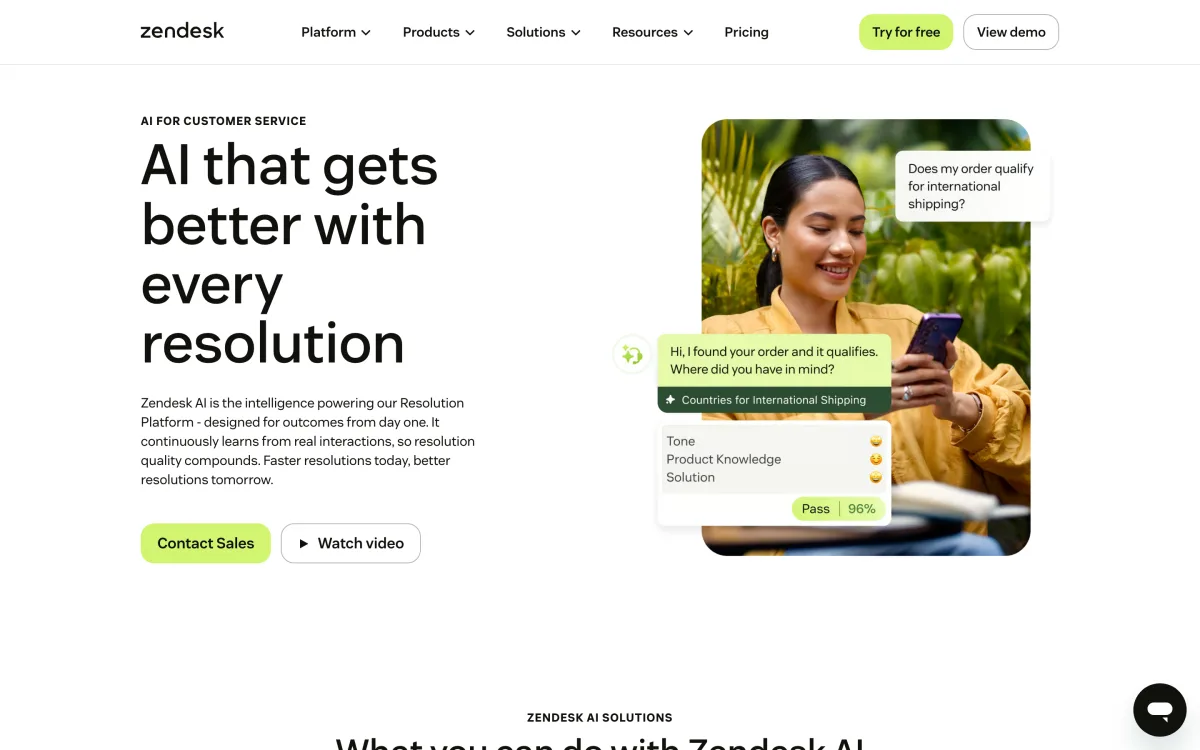
Zendesk spent 2026 rebuilding itself around what it calls the Resolution Platform — AI agents trained on billions of ticket interactions, sold with outcome-based pricing. The pitch is straightforward: you pay per issue the AI resolves autonomously — Zendesk doesn't publish the per-resolution rate, so it's quoted by sales — on top of per-agent seat fees that run $19–$115/agent/month across the Suite plans. The agent-assist Copilot is a separate add-on again, at $50/agent/month. It's genuinely one of the most capable AI support stacks on the market, and the omnichannel coverage — email, chat, voice, social — is hard to match.
The catch is weight. Zendesk assumes you have a support organisation: admins, workflows, triggers, a budget line. For a company already standardised on Zendesk, adding its AI agents is the path of least resistance and the results are good. For a ten-person business, you'd be buying an aircraft carrier to cross a river — and the resolution fees stack on top of seats you're already paying for.
Best for: enterprises and large support teams already living in the Zendesk ecosystem.
2. Intercom Fin — the AI agent benchmark
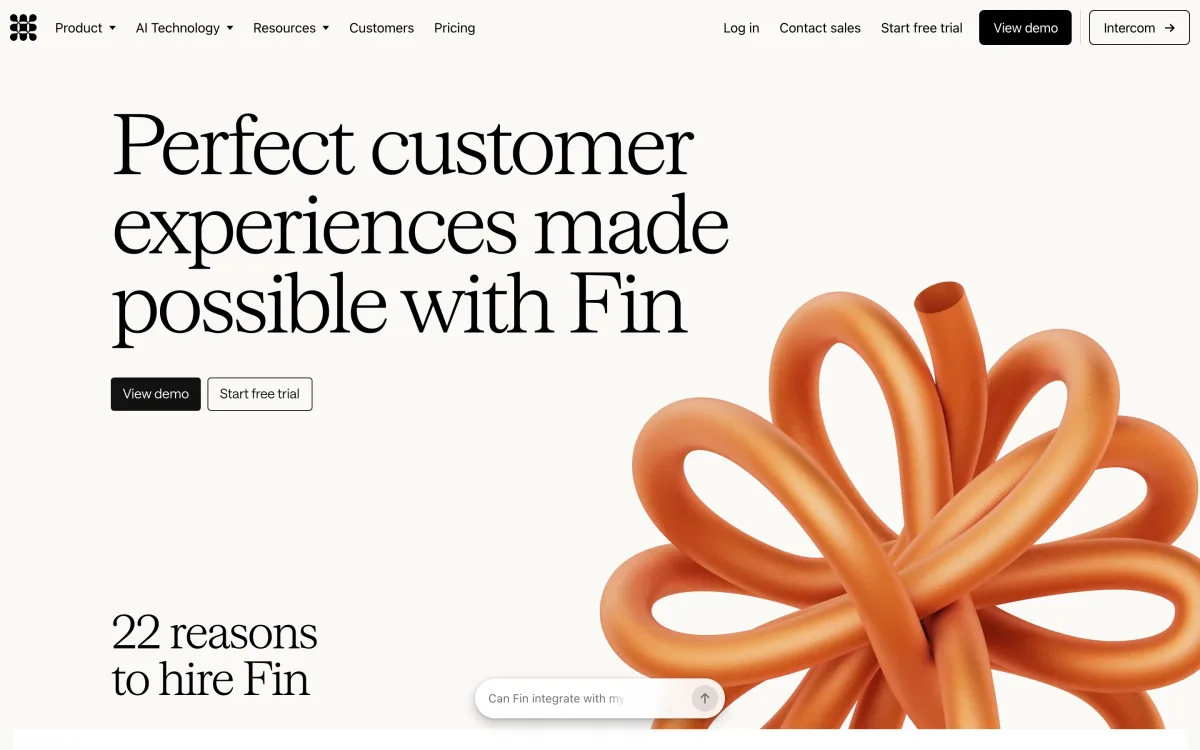
Credit where due: Fin is the AI agent everyone else measures against. It answers from your help content, executes multi-step procedures, hands off cleanly, and now speaks on the phone too. Intercom went all-in — the company even renamed its corporate entity to Fin in May 2026, and Salesforce agreed to acquire it for approximately $3.6 billion in June. Whatever happens post-acquisition, the product today is excellent.
Pricing is per outcome: $0.99 per resolution as reviewed on 26 August 2026. That sounds cheap until you model it: real-world resolution rates plus seat costs for your human team mean a busy support org can see four-figure monthly bills that scale with traffic. And Fin's DNA is SaaS support — for store-specific jobs like live catalog search and order lookups, it leans on integrations rather than doing it natively. We wrote a full breakdown in our Intercom alternatives for e-commerce guide.
Best for: SaaS companies and larger support orgs that want the most proven AI agent and can absorb per-resolution economics.
3. Tidio — the approachable all-rounder
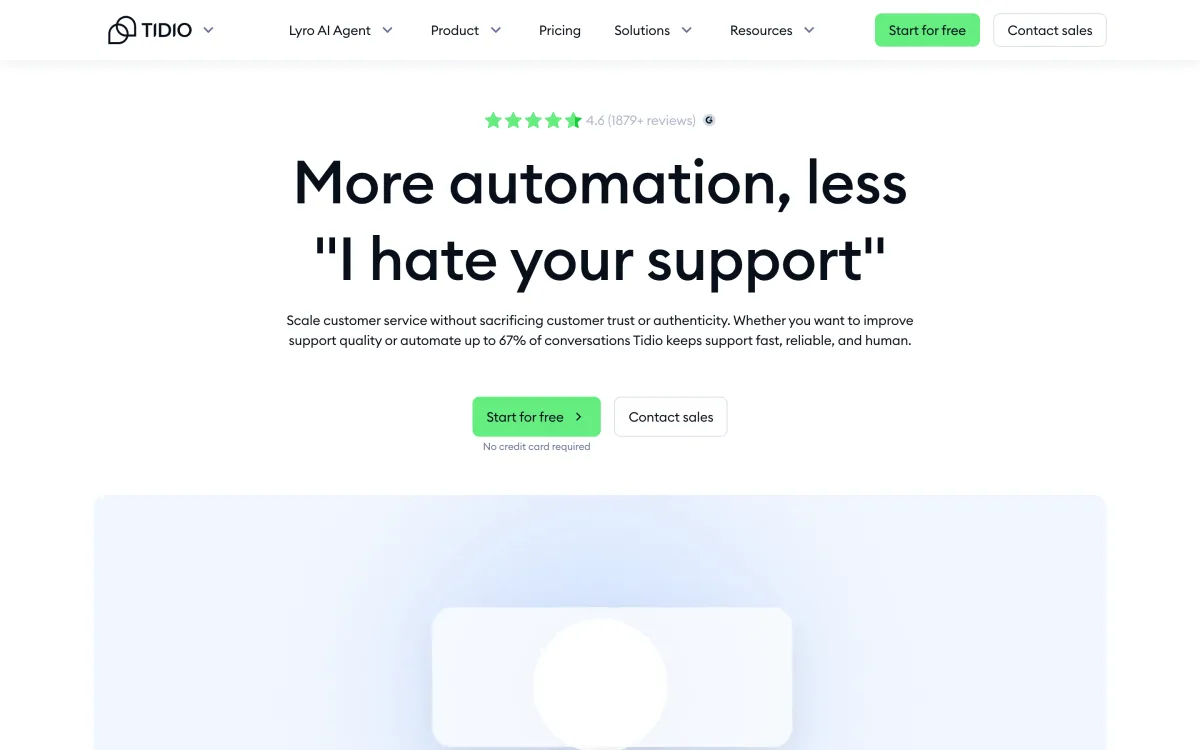
Tidio remains the friendliest entry point in the category: a polished live-chat widget, a genuinely pleasant visual flow builder, and enough integrations to cover most small-business setups. If you like the idea of designing conversations by hand — "if customer asks X, show buttons Y and Z" — nobody makes that easier.
The confusion is in the billing. Tidio charges per billable conversation — any thread a human agent replies to — not per seat, and Lyro, the AI agent you're probably picturing, runs on its own separate meter: the free plan includes a one-time 50 AI conversations, and paid Lyro starts around $32.50/month on annual billing. Human-conversation plans run from about $24/month (Starter, 100 conversations) through Growth from ~$49/month, then jump to a Plus tier from $300/month plus usage (Tidio pricing, July 2026). Two meters running at once — budget against your real conversation volume, not the sticker.
Best for: small businesses and beginners who want live chat plus hand-built flows, with light AI on top.
4. Gorgias — the e-commerce helpdesk veteran
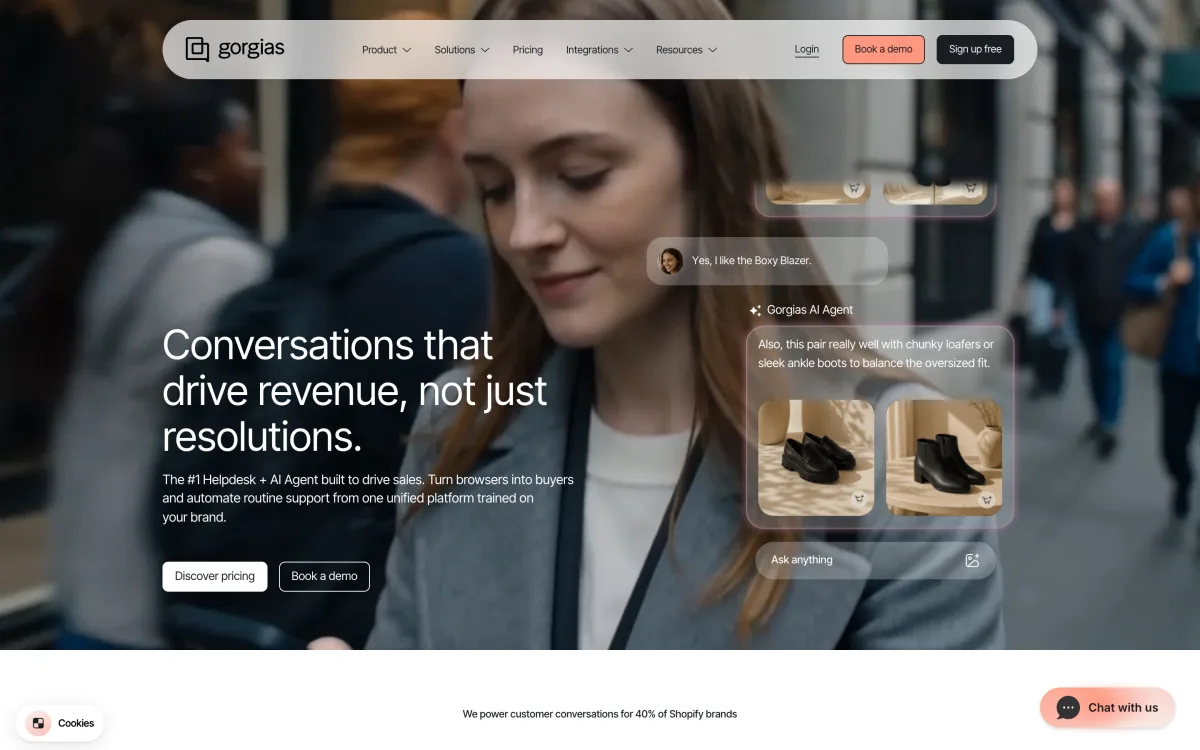
Gorgias is what happens when a helpdesk grows up entirely inside e-commerce. Email, chat, social, SMS, and voice flow into one inbox; the AI Agent can genuinely act — order edits, returns, refunds — because the Shopify integration runs deep. For an established store with a support team living in the inbox all day, it's arguably the most complete package in this list.
The economics are the thing to model carefully. Helpdesk plans are tiered by ticket volume (never per agent), while AI Agent is a separate add-on billed by resolved interaction. Gorgias's current AI pricing guide publishes $0.90 per resolved interaction on most annual plans, with starter and monthly rates beginning at $1. A conversation fully resolved by AI does not also count as a billable helpdesk ticket. Voice and SMS are separately billed add-ons that scale with call and text volume. None of this is unreasonable at scale; it just means lean stores often pay for helpdesk machinery they don't use yet. If that's you, see our Gorgias alternatives rundown.
Best for: established e-commerce brands with real ticket volume and a multichannel support team.
5. HubSpot Chatbot (Breeze) — best inside the CRM walls
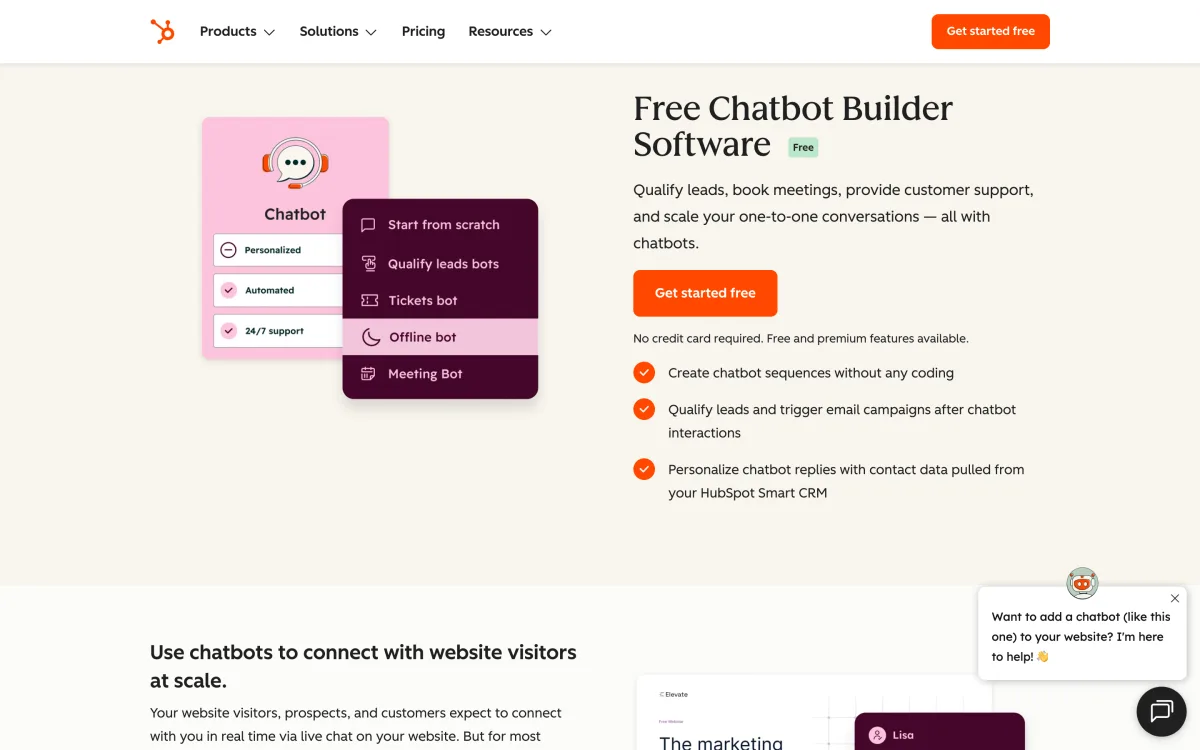
HubSpot's chatbot story has two layers: the old free rule-based Chatflows builder, and the newer Breeze Customer Agent — an AI agent that answers from your knowledge base and website content, cites sources, and escalates when its confidence drops. Because it lives inside the CRM, every conversation lands on a contact record automatically, which is the real superpower here: marketing, sales, and support see the same customer.
The trade-offs are control and cost accounting. Customisation of the AI's behaviour is limited compared to dedicated platforms, and pricing involves seats plus HubSpot Credits — the current HubSpot credit rate sheet charges credits when Customer Agent delivers a qualifying text resolution, while extra credits cost $0.01 each. If you're already paying for HubSpot, Breeze is an easy yes. Adopting the whole HubSpot suite just to get the chatbot rarely makes sense.
Best for: teams already running on HubSpot CRM who want support conversations tied to contact records.
6. Loqara — grounded chat + voice for online stores (that's us)
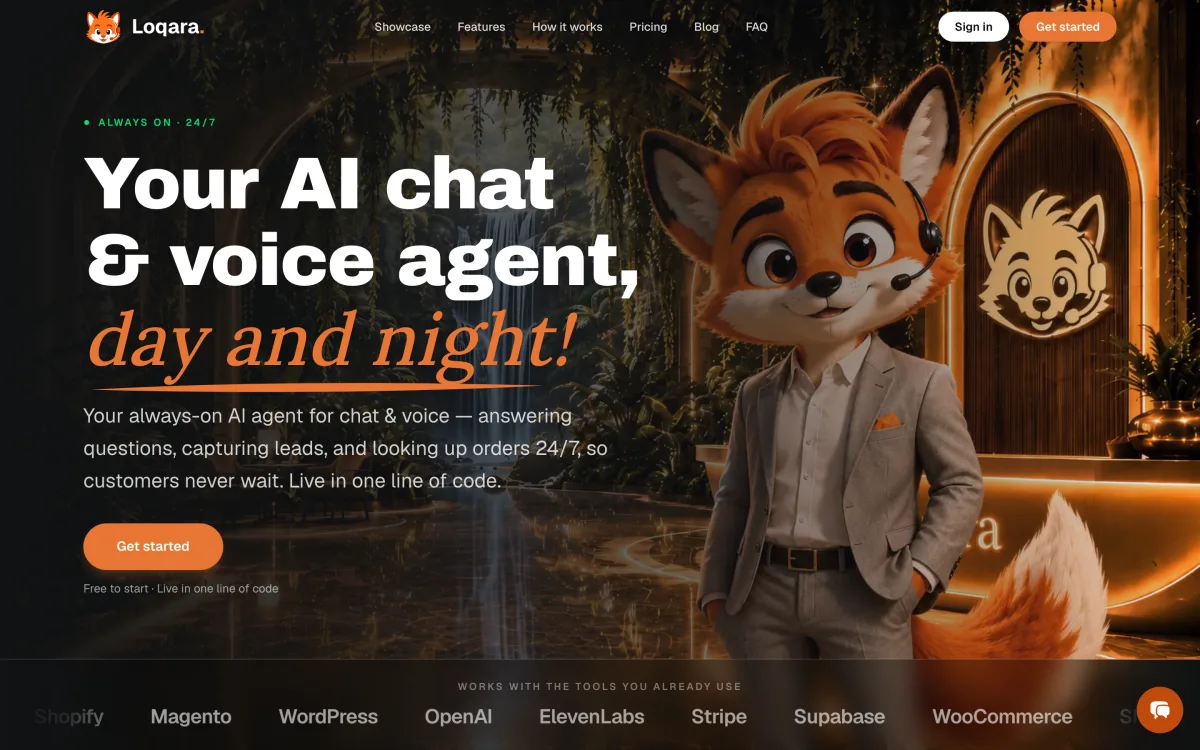
Full disclosure: Loqara is our product, so read this section with that in mind. What it does: a grounded AI agent that answers from approved store content and cites its sources, live product search across connected catalogs, identity-checked order lookup on WooCommerce and Magento (not Shopify), lead capture, human handoff on every plan, and AI analytics (conversation summaries, topics, 1–5 quality scores, CSAT). The unusual part is voice: an add-on (€49/month including ~200 minutes, then €0.20/min) lets customers literally talk to your store in the same widget. Install is one line; pricing is per conversation — Free at €0 for 100 conversations/month, then €149/€249/€449 tiers, no setup fees.
Now the honest limits. Loqara is young — the incumbents above have years of edge-case hardening we don't. It speaks English and Lithuanian only today, so if you need French or German support, pick something else. And it's deliberately e-commerce-focused: if you're a SaaS company or a bank, tools higher up this list will fit better. What we'd claim without blushing: for a small-to-mid online store that wants grounded answers, real store actions, and optional voice — without adopting a full helpdesk — the per-conversation pricing and free tier make it the cheapest honest way to find out if AI support works on your traffic. More context in our best AI chatbot for e-commerce guide.
Best for: small and growing online stores that want grounded AI chat + voice with predictable pricing.
7. Drift (Salesloft) — a warning, not a recommendation
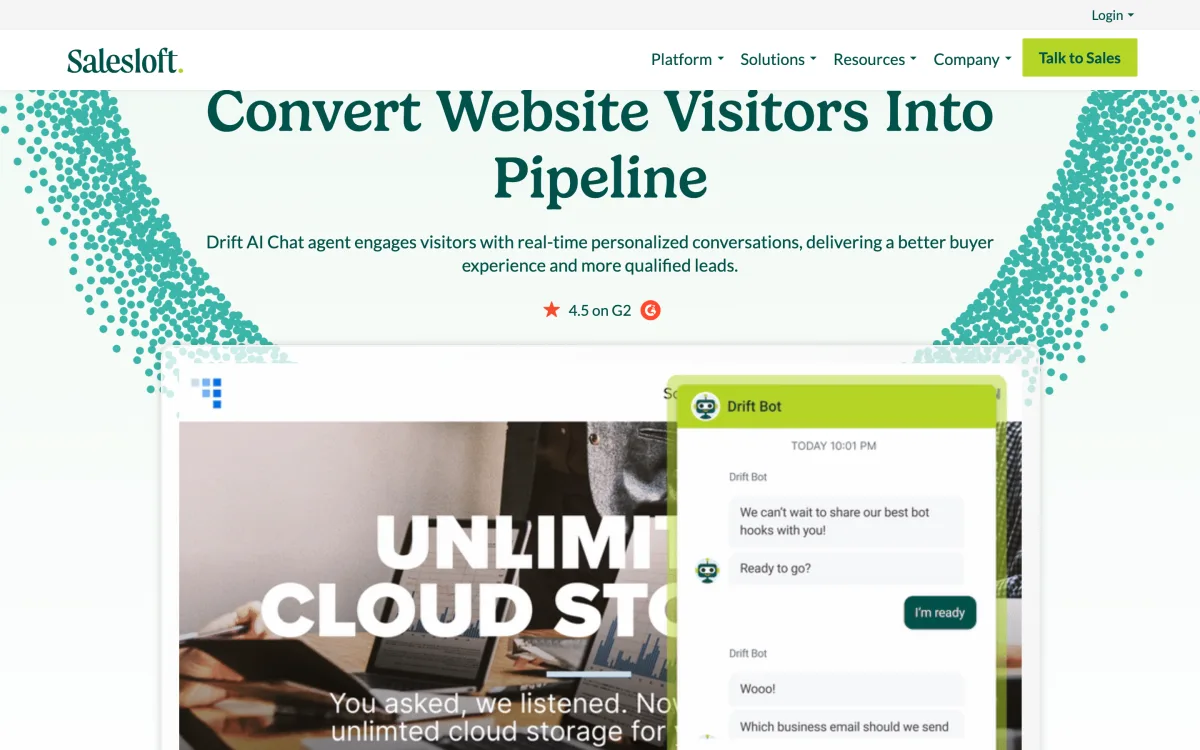
Drift essentially invented conversational marketing — the B2B playbook of chatbots that qualify visitors and book sales meetings. It deserves its place in this list's history section, but that's where it now belongs: after the 2024 Salesloft acquisition, an OAuth token breach in August 2025 that potentially affected more than 700 customer organisations and took Drift offline that September, and the Clari–Salesloft merger, the sunset of Drift was announced in March 2026.
If you're a Drift customer, the practical advice is simple: plan your migration now rather than waiting for a forced deadline. For sales-focused chat, the ecosystem has plenty of successors; for support-focused chat, everything else on this list is a live, maintained product. We include Drift here because people still search for it — not because you should start anything new on it.
Best for: existing customers planning an exit. Don't adopt it in 2026.
8. Crisp — the budget multichannel inbox
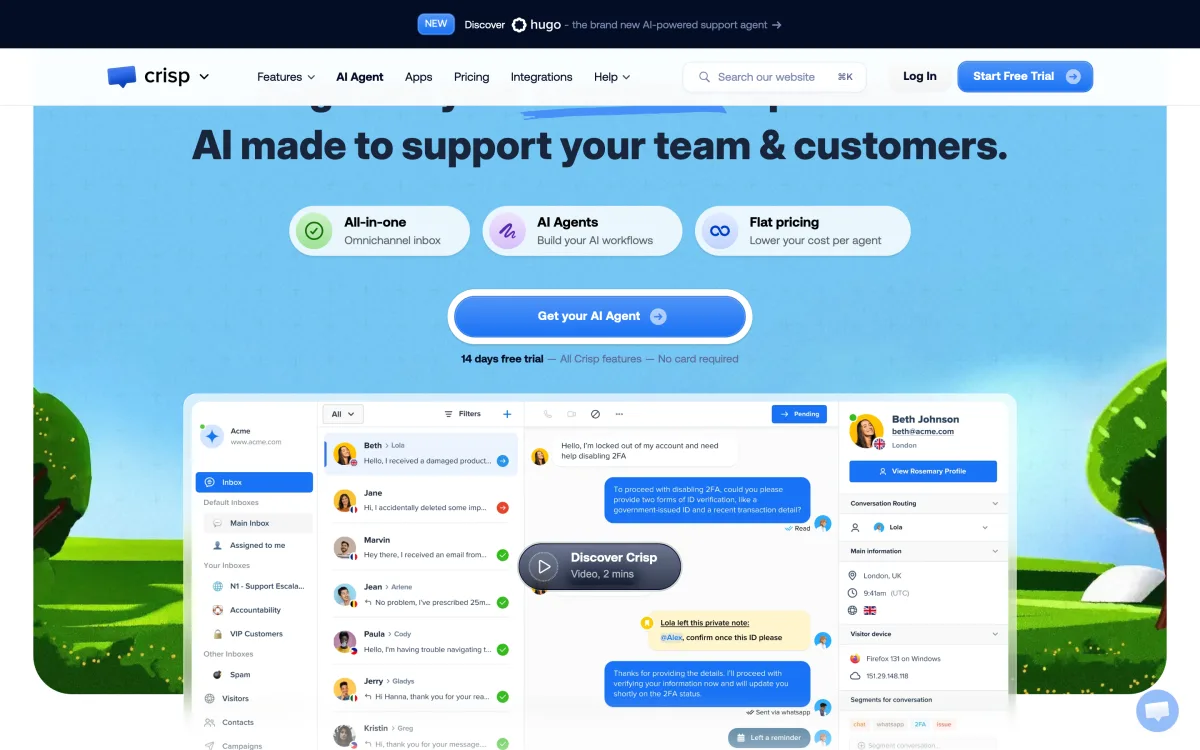
Crisp is quietly one of the best value propositions in customer messaging: a clean shared inbox, live chat, a knowledge base, campaigns, and a long integration list, priced per workspace rather than per seat — which gets genuinely cheap for small teams as headcount grows. The product is fast, the widget is pleasant, and the free tier is usable.
The asterisk is AI usage, not access. Crisp's Hugo AI Agent is available from the $45/month Mini plan, with monthly AI credits included across paid tiers: roughly 90 automated conversations on Mini, 450 on Essentials, and 1,350 on Plus according to Crisp's current pricing. That makes it a credible knowledge-trained agent as well as a shared inbox. Store-specific actions still depend on integrations rather than a native commerce toolset, so model both the credit allowance and the integration work.
Best for: budget-conscious small teams that want a multichannel inbox first and AI second.
9. Chatbase — build a bot on your own data in an afternoon
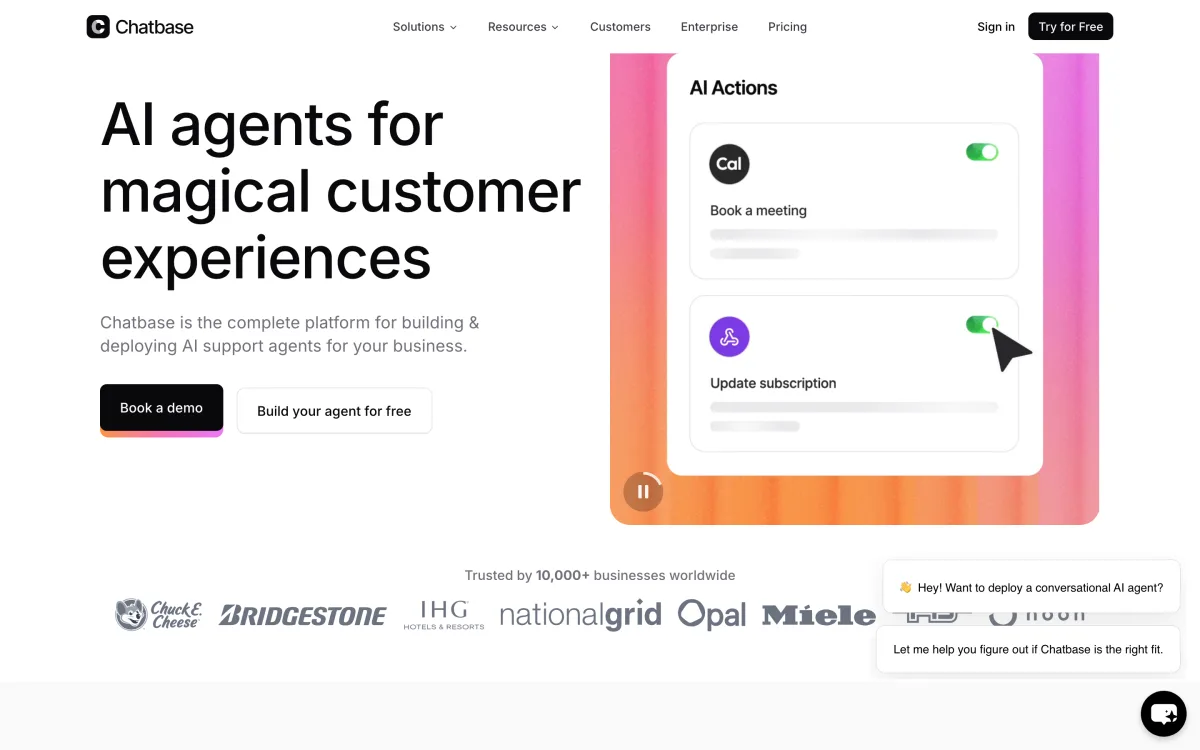
Chatbase rode the "train ChatGPT on your data" wave into a real product: upload documents or point it at your site, and you have a working AI agent embeddable anywhere, with AI Actions for calling external APIs and even voice and telephony on higher tiers. For a generic "answer questions about my content" bot, the speed from zero to live is genuinely impressive.
The costs live in the details. Plans are metered in message credits ($0 free through $400/month Pro), and the extras add up: additional agents at $300/agent/year, extra credits at $40 per 1,000 when you run dry, and — the one that surprises people — removing the "Powered by Chatbase" branding costs $1,188/year on its own. It's also a horizontal tool: no native store integrations, so order lookups and product search mean building your own API actions.
Best for: technical DIYers and small teams that want a custom-data bot fast and don't need commerce features out of the box.
10. Voiceflow — the pro builder's platform
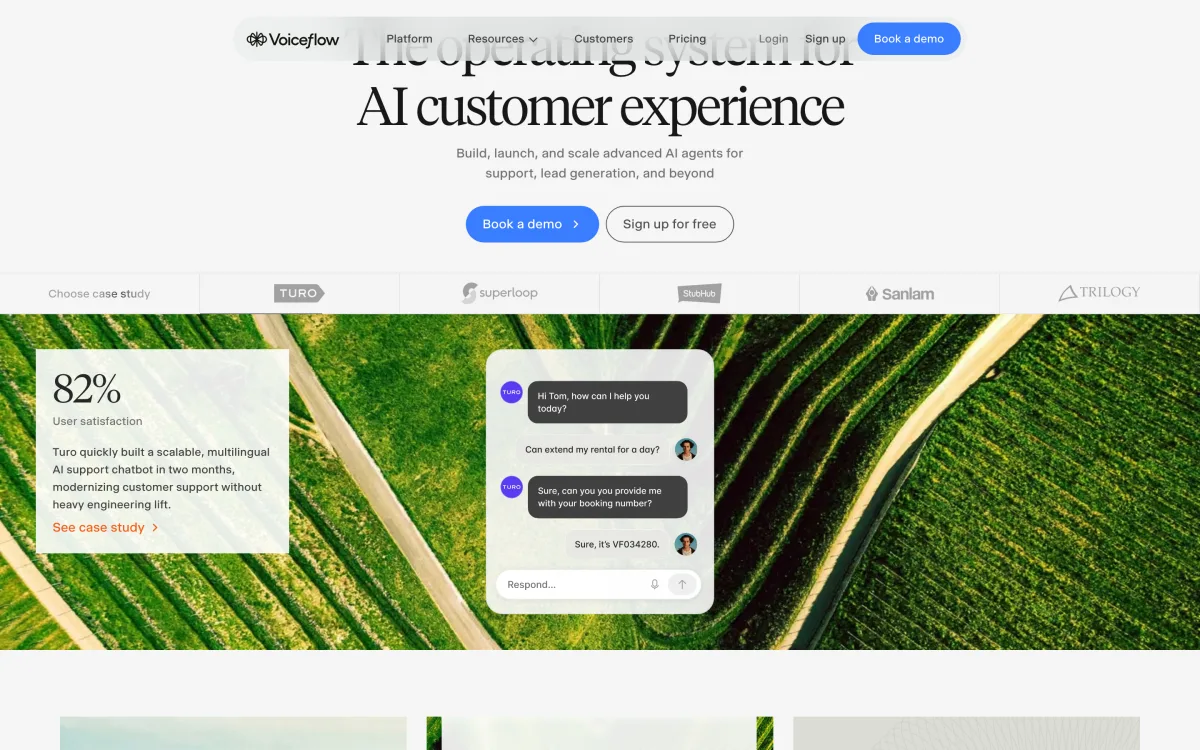
Voiceflow is last on this list only because it answers a different question. It isn't a chatbot you install; it's the platform agencies and product teams use to design and ship agents — a visual canvas for conversation logic, knowledge bases, your choice of LLMs, and deployment to web chat, voice, and telephony. In the right hands it's the most flexible tool here, and its multi-client workspaces make it a favourite for agencies building bots as a service.
That flexibility is the cost. You are the builder: answer quality, integrations, and maintenance are your job, and the usage-based billing — Voiceflow no longer publishes plan prices; you trial or request a quote — rewards teams who treat the bot as a product, not a plugin. A store owner who just wants questions answered should be nowhere near it; a team with a conversation designer will feel at home.
Best for: agencies and product teams building custom agents for clients or complex use cases.
How do I actually choose?
Match the platform to your situation, not the hype
Enterprise support org → Zendesk or Intercom Fin. E-commerce with a real support team → Gorgias. Small store that wants grounded AI + voice → Loqara. Already on HubSpot → Breeze. Love building flows → Tidio. Tight budget, inbox-first → Crisp. You're the builder → Chatbase or Voiceflow. And whatever you pick: model your real monthly volume against the pricing unit — per resolution, per conversation, per credit — because the same traffic can cost 3–4× more on one model than another.
One last pattern worth naming: almost every vendor above moved to some form of usage-based AI pricing in 2025–2026 — per resolution, per outcome, per credit. That's fine, but it shifts risk onto you. Before committing, run a one-month trial on real traffic and look at the actual invoice, not the calculator on the pricing page.
Frequently asked questions
What is the best chatbot platform in 2026?
There's no single winner — it depends on your size and use case. Intercom Fin and Zendesk AI lead for enterprise support, Gorgias for established e-commerce teams, Tidio for small-business DIY, Voiceflow for agencies, and Loqara (our product) for online stores that want grounded AI chat and voice with per-conversation pricing.
How much does a chatbot platform cost?
As reviewed on 26 August 2026, anywhere from free to four figures monthly. The pricing unit matters more than the sticker: Intercom starts at $0.99 per outcome, Gorgias publishes about $0.90 per resolved interaction on most annual plans, and Zendesk quotes its automated-resolution rate; credit systems such as Chatbase and HubSpot scale with usage; per-conversation models such as Loqara (from €0 to €449/month) are easier to forecast. Always check the vendor's current pricing page.
What happened to Drift?
Drift was acquired by Salesloft in 2024, suffered a major OAuth token breach in August 2025 that took the product offline that September, and after the Clari–Salesloft merger its sunset was announced in March 2026. Existing customers should plan a migration; new buyers should choose an actively maintained platform.
Do I need an AI chatbot or a rule-based one?
In 2026, AI-first is the default: grounded AI agents answer natural questions from your real content and hand off when unsure, while rule-based flows only handle the paths you predicted. Rules still make sense as a supplement — structured lead capture, menu-style navigation — but as the primary experience they frustrate more customers than they help.
Which chatbot platform is best for e-commerce?
Gorgias if you're an established brand needing a full multichannel helpdesk; Loqara if you're a small-to-mid store that wants grounded answers, product search, optional voice, and WooCommerce/Magento order lookup without helpdesk overhead. Our e-commerce chatbot guide compares the store-specific options in depth.
The honest bottom line: the "best chatbot platform" is the one whose pricing unit, integration depth, and weight class match your business — not the one at the top of anyone's list, including this one. Shortlist two, trial both on real traffic, and let the invoices and transcripts decide.
Vendor features and prices were reviewed against official sources on 26 August 2026. They remain approximate; check each vendor's current pricing and contract terms before you commit.