AI for e-commerce · August 14, 2026 · 11 min read
AI chatbot for auto-parts stores: verify fitment before purchase

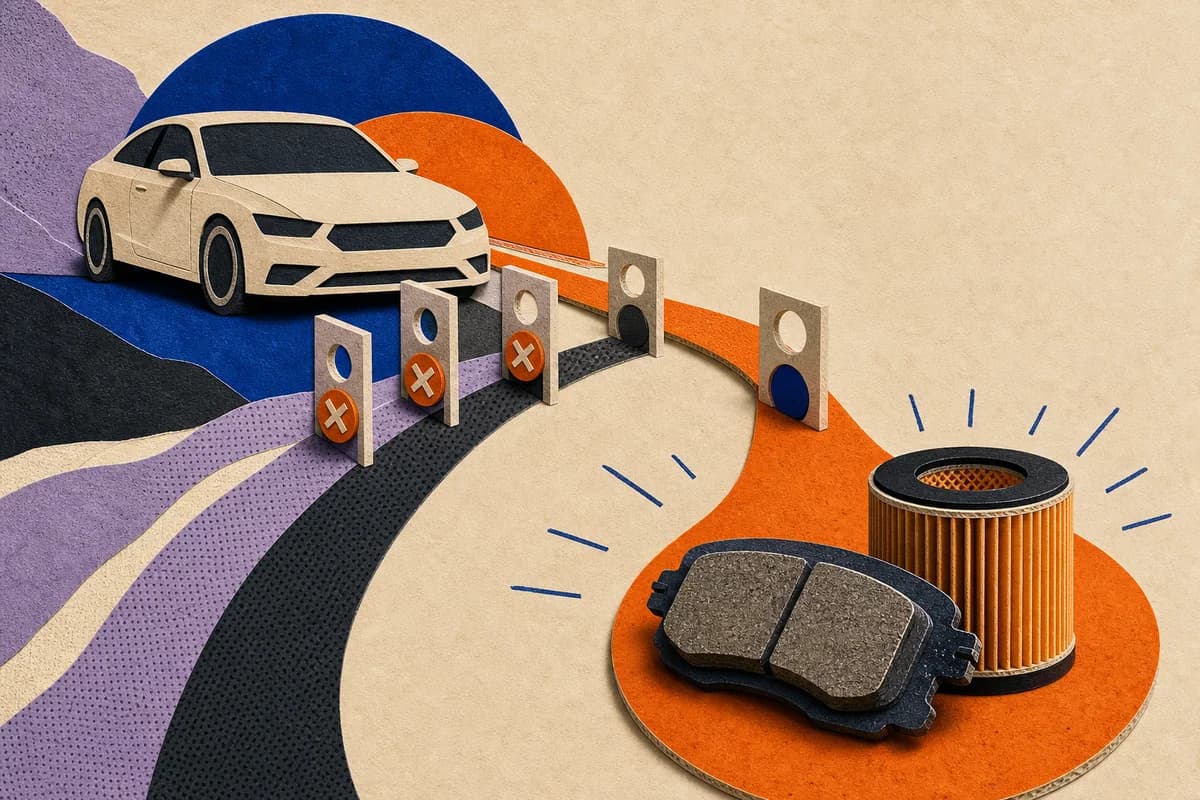
The wrong brake pad, filter, lamp, sensor, or wiper may look almost identical to the right one. A category match is not a vehicle match.
An auto-parts assistant becomes useful when it can turn “I need this for my Golf” into an exact vehicle and part relationship, retrieve evidence, and exclude anything it cannot verify. If it merely searches titles for the word “Golf”, it adds confidence to the same mistake a careful parts specialist would prevent.
An AI chatbot for an auto-parts store helps shoppers identify the exact vehicle and required part, then checks current catalog fitment, identifiers, specifications, and exclusions before showing products. It should never infer compatibility from appearance or a partial model name, and must route uncertain, safety-critical, modified, or undocumented vehicles to a qualified specialist.
Quick take
- Vehicle name is not enough: year, generation, engine, body, drivetrain, market, or build date can change fitment.
- Fitment is a gate: popularity and price matter only after compatibility is verified.
- Identifiers matter: MPN, GTIN, OEM reference, and exact application evidence prevent fuzzy matches.
- Modifications break assumptions: aftermarket wheels, brakes, suspension, or engine changes need specialist review.
- Unknown is a valid result: no verified match is better than an expensive guess.
Why is auto-parts search harder than ordinary product search?
An ordinary product recommendation asks which available item best matches a shopper’s preferences. Auto-parts search must first prove that the item applies to a specific configuration.
“2018 BMW 3 Series” may still leave unanswered questions about:
- generation and production month;
- engine code, capacity, fuel type, or power output;
- saloon, estate, coupé, or another body style;
- drivetrain, transmission, axle, brake, or suspension package;
- left- or right-hand drive;
- regional market and homologation;
- original equipment versus later modification;
- the exact part position or side.
Google’s Merchant Center guidance uses car parts as its example of products whose compatibility cannot be represented safely as ordinary variants. It tells merchants to submit each unique part once and put the target make and model in the description, supported by proper brand, MPN, or GTIN identifiers (Google Merchant Center, unsupported variants).
That is a useful minimum. A good store assistant needs an even more explicit fitment relationship.
What should the assistant ask about the vehicle?
Use progressive clarification. Ask for the smallest set of facts that resolves the relevant category.
| Category | Likely vehicle details | Additional part evidence |
|---|---|---|
| Oil or air filter | Year, make, model, engine | Existing part number or filter dimensions |
| Brake components | Generation, axle, disc size, brake system or PR code | VIN/build data or old part markings |
| Lamp or bulb | Year, model, body, lamp position and technology | Socket, voltage, existing bulb code |
| Wiper blades | Year, body style, position | Length and attachment type |
| Battery | Engine, fuel, start-stop system, dimensions | Capacity, cold-cranking rating, terminal layout |
| Suspension part | Generation, axle, drivetrain, suspension package | OEM reference and side |
| Body or trim part | Generation, body style, market, position | Colour/finish and mounting details |
Do not ask for every possible field at the start. The correct questions for a cabin filter differ from those for a wheel bearing. A category-aware flow reduces friction and makes missing evidence visible.
How should fitment data be structured?
The assistant should not rely on one long product description. Use machine-readable relationships where possible:
- unique internal product ID;
- manufacturer, brand, MPN, GTIN, and legitimate cross-references;
- supported vehicle applications with year/build ranges;
- make, model, generation, body, engine, drivetrain, market, axle, and position when relevant;
- explicit exclusions and notes;
- dimensions, material, electrical values, ratings, and required companion parts;
- superseded and replacement part numbers with source dates;
- kit contents and quantity per vehicle;
- evidence source and revision;
- exact variant price, stock, image, and URL.
The automotive aftermarket already uses the ACES and PIES standards to exchange fitment and product information in machine-readable form. Auto Care explains that ACES communicates applications while PIES communicates product information (Auto Care Association, PIES). A store does not need to expose those raw standards to shoppers, but its assistant needs equivalent clarity.
The same source discipline should govern the questions the assistant answers. A verified product Q&A workflow keeps each claim tied to current manufacturer, fitment, and merchant evidence instead of turning repeated shopper questions into repeated guesses.
What does a trustworthy parts conversation look like?
Consider:
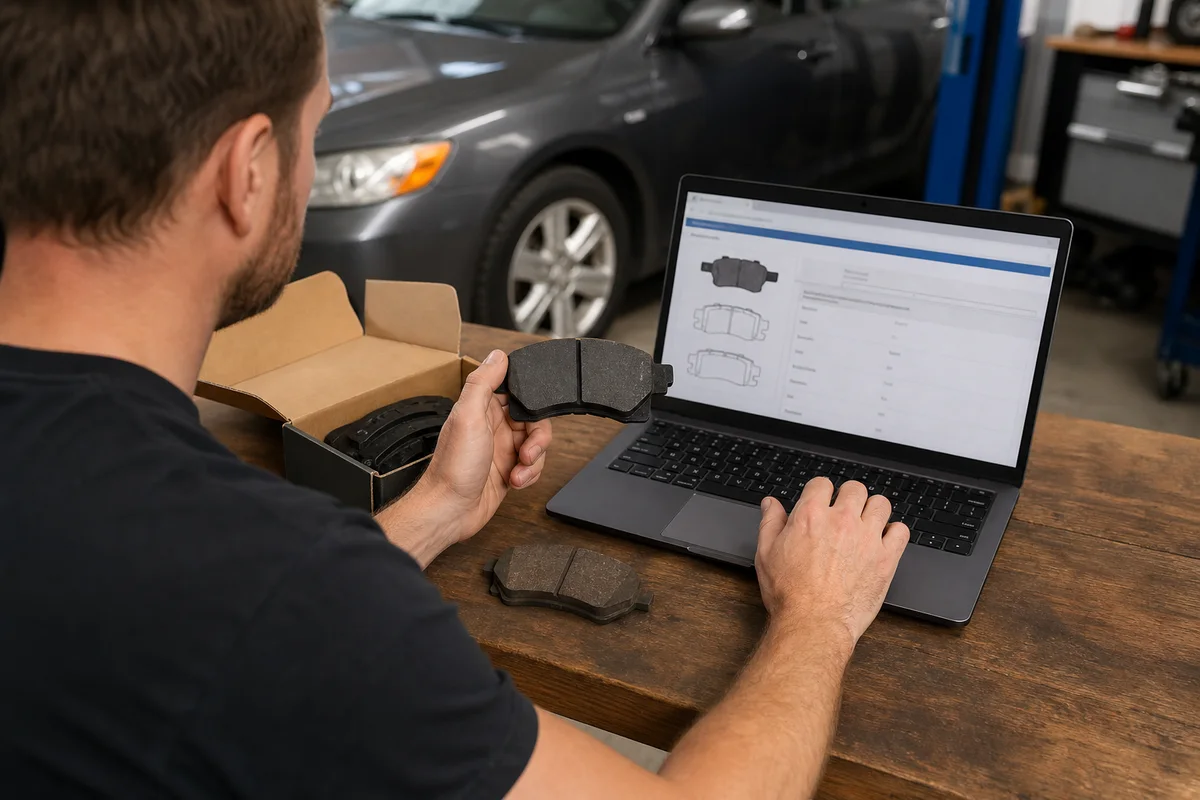
“I need front brake pads for a 2019 Audi A4 2.0 diesel.”
A weak assistant returns products containing “Audi A4 2019”.
A trustworthy assistant responds:
“I need the exact brake system or a VIN-based lookup because this model-year and engine can use more than one front-brake configuration. If you can provide the current pad/OEM number, disc diameter, PR code, or VIN through the store’s approved lookup, I can narrow the catalog. I will not label either current result compatible from model and engine alone.”
Once evidence exists, the answer can say:
“This pad set is listed for the identified front-brake configuration and cross-references OEM number X. The listing contains four pads for one front axle. I excluded the cheaper set because its application note names a different brake package.”
The useful outcome is not always a product. Sometimes it is the exact missing identifier that lets a specialist finish the lookup.
Can the assistant use a VIN?
A VIN can help identify a vehicle configuration when the store has an authorised decoder or fitment service connected to the workflow. The language model should not decode a VIN from memory or claim that the VIN alone proves every installed component.
Important boundaries:
- tell the shopper why the VIN is requested;
- protect it according to the store’s privacy policy;
- use a current, authorised data source;
- show which vehicle attributes were returned;
- account for production changes and modifications;
- do not retain or repurpose the VIN without a legitimate need.
Without a connected decoder, Loqara can collect a VIN for a human specialist if the merchant chooses, but it does not independently turn that VIN into authoritative fitment data.
What should an auto-parts chatbot never claim?
It should never say:
- “It looks the same, so it will fit.”
- “This fits every version of that model.”
- “Matching one OEM number guarantees the whole application” when exceptions exist.
- “Universal” without the documented limits and installation requirements.
- “Genuine” or “OEM” for an aftermarket product.
- “Safe upgrade” without approved engineering evidence.
- “No coding or calibration is needed” unless the source states it.
- “The VIN confirms it” when no authorised lookup occurred.
Google also requires compatible third-party products to be described honestly. Its guidance says titles should signal “compatible”, “third party”, or the third-party manufacturer rather than presenting the item as original OEM equipment (Google Merchant Center, compatible products). The assistant should preserve that distinction.
How do modifications and safety-critical parts change the flow?
Modified vehicles invalidate catalog assumptions. Aftermarket wheels can change fastener requirements; suspension changes can affect clearances; an engine swap changes service parts; an upgraded brake kit makes the original vehicle application irrelevant.
Ask whether the relevant system remains standard. If not, route to a specialist who can inspect the installed components and documented modification.
Apply stronger handoff rules to braking, steering, restraint systems, tyres, high-voltage components, fuel systems, load-bearing parts, and other safety-critical categories. The assistant may retrieve published specifications and installation requirements. It should not improvise repair instructions or certify a vehicle as safe.
This is the same evidence-first pattern used by an electronics compatibility assistant, but vehicle application data adds build ranges, fitted systems, and modification risk.
How do you add an AI chatbot to an auto-parts store?
1. Start with a bounded category
Choose filters, wipers, bulbs, batteries, or another category with a stable lookup process. Do not launch every mechanical and electronic system at once.
2. Document the specialist’s real questions
Ask counter staff which vehicle facts and part markings they use. Turn those into category-specific clarification rules rather than a generic form.
3. Connect fitment and product evidence
Keep the fitment source, catalog product, variant, stock, and price distinguishable. A semantic product match is only a candidate until the application data verifies it.
4. Preserve exact identifiers
Do not translate, shorten, or “correct” brand names, MPNs, OEM references, engine codes, or fitment codes. Normalise punctuation for lookup only when the authoritative data supports it.
5. Define no-match and handoff behaviour
Ask for an old part number, label photo, measurement, or specialist review. Explain why the current information is insufficient. Never relax a fitment requirement silently.
6. Test near-misses
Include adjacent build years, the same model with two engines, different body styles, left/right and front/rear parts, superseded numbers, a modified vehicle, an incomplete VIN flow, and a visually similar but incompatible item.
What can Loqara do—and what remains separate?
Loqara can:
- ask category-specific questions in natural language;
- search product information exposed by supported connected stores;
- answer from approved fitment tables, product documents, and policies added as knowledge;
- show current candidate products and capture unresolved requests;
- hand the conversation to a person.
Loqara does not include an automotive fitment database or VIN decoder by default. It does not certify part compatibility, inspect a modified vehicle, write to the store catalog, perform a repair, or approve a safety-critical installation. The merchant must provide authoritative fitment evidence and define the specialist route.
Which metrics matter?
| Metric | What it reveals |
|---|---|
| Vehicle-identification completion | Whether shoppers can provide decisive details |
| Verified-fitment rate | How often evidence supports an exact item |
| No-match rate | Missing inventory, coverage, or application data |
| Wrong-part return rate | Whether assisted purchases still fail on fitment |
| Near-miss rejection rate | Whether incompatible popular items are excluded |
| Handoff reason | Which categories need specialist knowledge |
| Identifier coverage | How many products have usable MPN/GTIN/OEM references |
| Unsupported-claim rate | Whether the assistant exceeds evidence; target zero |
Measure by category. Wipers may achieve high self-service while brake components should intentionally create more specialist handoffs. A higher handoff rate is not a failure when the alternative is guessing.
Frequently asked questions
Can an AI chatbot guarantee that a car part fits?
It can state that a part is listed for an exact vehicle configuration in an approved, current source. It should not give an unconditional guarantee when the build date, fitted system, regional version, modification, or installed part remains unknown.
Is year, make, and model enough?
Sometimes for simple categories, but often not. Engine, body style, drivetrain, production date, axle, brake system, market, or other equipment may change eligibility. Ask only for the fields relevant to that category.
Can a shopper upload a photo of the old part?
A photo can reveal labels, connector shapes, mounting points, and damage, but it should be treated as supporting evidence. Visually similar parts may differ internally. Confirm the identifier and vehicle application before recommending.
Can the chatbot cross-reference OEM numbers?
Yes, when the merchant supplies an approved cross-reference source. The response should distinguish original, equivalent, remanufactured, and compatible third-party products rather than presenting every match as OEM.
Does Loqara decode VINs?
Not by default. A merchant would need an authorised VIN or fitment data service integrated into the workflow. Without one, Loqara can collect the detail for a specialist but should not invent a decoded configuration.
Can it give installation instructions?
It can retrieve approved manufacturer instructions within the merchant’s defined scope. Safety-critical repairs, damaged parts, missing procedures, calibration, coding, torque, or uncertainty should reach qualified help rather than improvised instructions.
The honest bottom line: the best parts assistant is comfortable saying “I need one more identifier” before it says “this fits”.
Try Loqara free with one parts category, current application evidence, and a specialist route for every configuration the catalog cannot prove.