AI for e-commerce · July 25, 2026 · 12 min read
AI chatbot for beauty and skincare stores: guide without medical claims

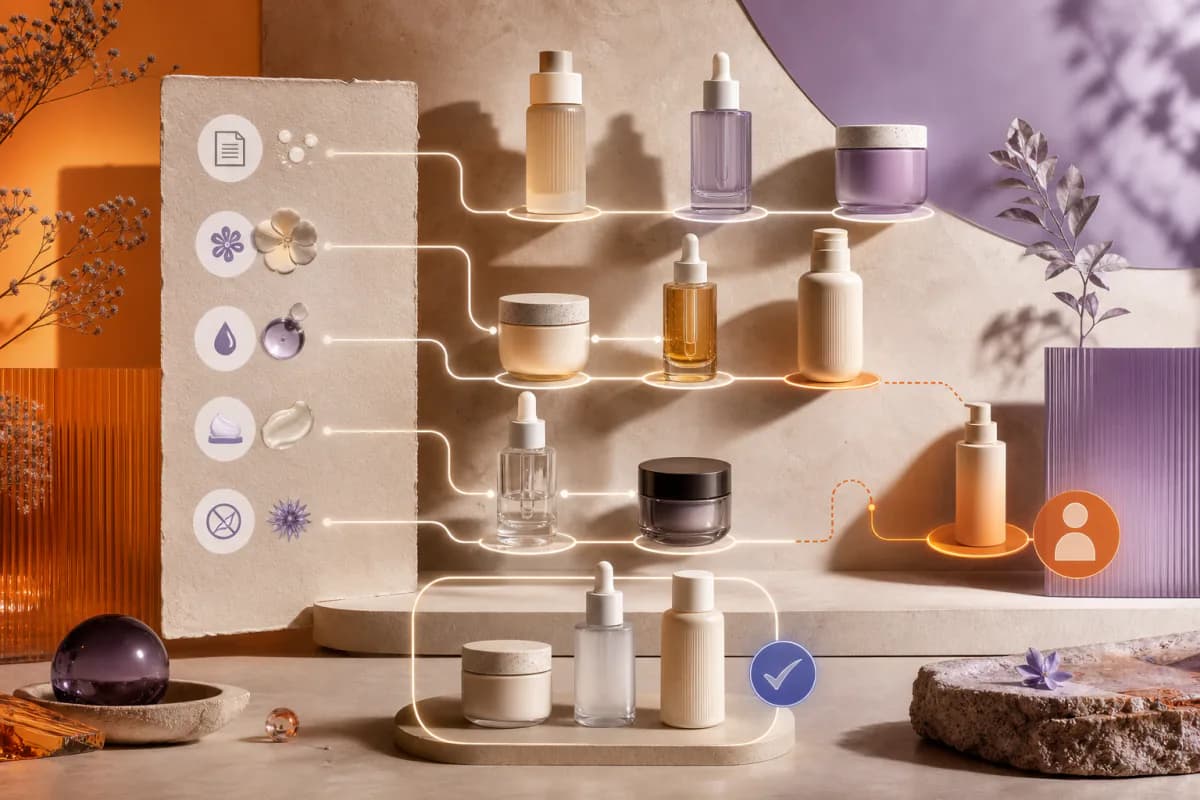
Beauty shoppers do not always arrive with a product name. They arrive with a routine, a preference, an ingredient they avoid, a texture they dislike, and three products that look almost identical.
That creates a useful role for conversation:
“Show me an unfragranced cleanser with a cream texture, under €25, and tell me which published ingredient list you checked.”
An AI chatbot for beauty and skincare stores can answer that kind of catalog question. It should not diagnose a skin condition, determine whether a product is medically safe for an individual, or turn cosmetic copy into a treatment promise.
An AI chatbot for beauty and skincare stores can help shoppers compare published ingredient lists, fragrance statements, textures, formats, routine steps, prices, and availability. It should describe only verified product information, avoid diagnosis and treatment claims, never guarantee that a product is allergy-safe, and route reactions or medical questions to appropriate professional help.
Quick take
- Guide products, not bodies: the assistant can explain what a product says and contains, not diagnose the shopper.
- Ingredients need exact variants: formulas can differ by shade, region, format, or reformulation date.
- Marketing labels are not guarantees: terms such as “hypoallergenic” do not prove that nobody will react.
- Preferences are safer than predictions: “fragrance-free and lightweight” is a catalog filter; “safe for your allergy” is a medical conclusion.
- Adverse reactions leave commerce: stop product recommendation and direct the shopper to the product’s approved safety information and qualified care.
Why are beauty and skincare strong conversational use cases?
Beauty catalogs combine objective product facts with subjective preferences:
- product type and routine step;
- finish, texture, coverage, hold, or format;
- shade and colour family;
- fragrance or published fragrance-free statement;
- ingredient inclusion or exclusion;
- packaging and application method;
- vegan or certification claims where documented;
- price, size, availability, and delivery;
- compatibility within a published product routine.
The shopper may not know the store’s categories. “Something light under makeup that does not smell floral” can span several filter labels. A product recommendation chatbot can translate that natural language into a shortlist when the catalog contains reliable attributes.
The risk appears when the same conversation drifts from product guidance into health judgment.
Where is the line between product guidance and medical advice?
Use this practical boundary:
| The assistant can describe | The assistant should not decide |
|---|---|
| Published ingredient list | Whether an ingredient is safe for this individual |
| Manufacturer’s fragrance statement | Whether the product cannot trigger a reaction |
| Product texture, format, finish, and routine step | What condition the shopper has |
| Directions and warnings on the approved label | How to treat acne, eczema, rosacea, infection, or another condition |
| Documented cosmetic claims | Whether a product will change body structure or function |
| Known product exclusions from current data | Whether an unlisted trace substance is absent |
| Store return and contact policy | What to do medically after a serious reaction beyond approved escalation |
The US Food and Drug Administration explains that claims about treating or preventing disease, or affecting the structure or function of the body, can make a cosmetic a drug under US law (FDA, Cosmetic Labeling Claims). Other markets have their own rules, but the operational lesson travels well: do not let an assistant upgrade cosmetic product copy into a medical promise.
Why must “hypoallergenic” and “for sensitive skin” be handled carefully?
The FDA states that there are no US federal standards or definitions governing the use of “hypoallergenic,” and manufacturers are not required to substantiate the term to the FDA (FDA, Hypoallergenic Cosmetics).
The FDA also notes that claims such as “fragrance-free,” “hypoallergenic,” or “for sensitive skin” do not guarantee that a product will not cause a reaction; consumers who are concerned about allergens should review the ingredient panel (FDA, Allergens in Cosmetics).
A safe assistant can say:
“The current product page describes this item as fragrance-free, and the published ingredient list is here. That wording is not a guarantee that no individual will react. If you have a known allergy, compare the complete label and follow advice from your qualified healthcare professional.”
It should not say:
“This is safe for sensitive skin.”
What should a beauty recommendation conversation ask?
Ask about the product decision, not for a diagnosis.
Useful questions include:
- Which product type or routine step are you looking for?
- Which texture or format do you prefer?
- Do you want a particular finish, coverage, or hold?
- Is fragrance a preference you want to exclude?
- Are there named ingredients you want included or excluded from the published list?
- Which current products must it layer or pair with according to the brand guidance?
- What size and budget work for you?
- Which country are you shopping from, if formulas or availability differ?
Avoid questions such as “What skin disease do you have?” or “Upload a photo so I can diagnose the rash.” If a shopper volunteers a medical condition, keep the response within product facts and professional escalation.
What product data does the assistant need?
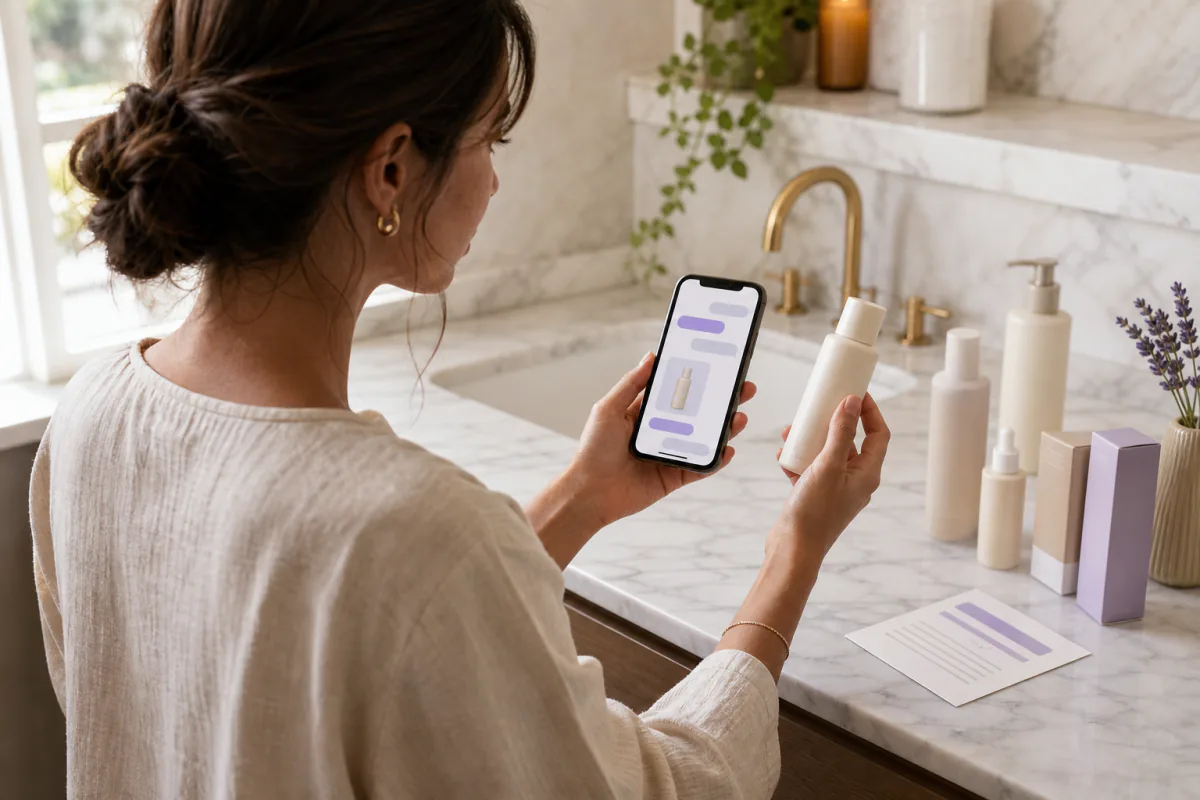
The product record should include:
- exact product and variant identifier;
- complete current ingredient list as published;
- formula or label revision date where available;
- region, shade, scent, and format variations;
- product type and intended cosmetic use;
- texture, finish, coverage, hold, or application attributes;
- size and packaging format;
- approved directions and warnings;
- documented claims and certifications with sources;
- current price, availability, and canonical URL;
- return or hygiene-policy details;
- customer-service and adverse-event contact route.
Ingredient lists should not be reconstructed from marketing copy. Formula information can change, and an online list may lag the physical package. The assistant should remind shoppers to verify the label on the product they receive when exact ingredients matter.
The FDA notes that, apart from color additives, cosmetic ingredients are generally not subject to premarket approval in the US and that companies are responsible for product and ingredient safety (FDA, Cosmetic Ingredients). A chatbot is not an extra approval authority.
How should the assistant compare skincare products?
Align facts without declaring a universal winner.
| Comparison field | Product A | Product B | Safe interpretation |
|---|---|---|---|
| Product type | Cream cleanser | Gel cleanser | Different formats |
| Published fragrance statement | Fragrance-free | No statement available | Do not infer absence for B |
| Texture | Cream | Gel | Shopper preference |
| Named ingredient | Listed | Not listed | Verify current full label |
| Size | 150 ml | 200 ml | Objective comparison |
| Price | Current catalog price | Current catalog price | Retrieve live if possible |
| Individual suitability | Unknown | Unknown | Do not predict medically |
A useful summary might be:
“Product A matches your stated preference for a cream format and has a published fragrance-free statement. Product B is larger and less expensive per listed volume, but I could not verify a fragrance-free claim from the current product data. Neither comparison determines whether a product is medically suitable for you.”
This is helpful without pretending the assistant knows how a person’s skin will respond.
How should makeup and haircare guidance differ?
The same boundary applies, but the decision attributes change.
Makeup
Guide by format, finish, coverage, shade information, wear claims as published, applicator, size, and price. Shade matching from screens or photos is uncertain because lighting, camera processing, display settings, and oxidation can change appearance. Offer swatches, samples, or the store’s approved shade tool where available.
Haircare and styling
Guide by product type, format, finish, hold, scent preference, directions, and published hair-use description. Do not diagnose scalp conditions, hair loss, infection, or causes of breakage.
Fragrance
Guide by published notes, concentration, format, size, and brand description. Smell is subjective and cannot be guaranteed through text. Discovery sets or samples may be the honest recommendation.
What should happen when a shopper reports a reaction?
Stop recommending products.
The assistant should:
- acknowledge the report without diagnosing it;
- surface the product’s approved warning and manufacturer contact information;
- advise the person to seek appropriate medical help, especially for a serious or worsening reaction, using the store’s approved language;
- offer the store’s customer-service, return, and incident-reporting route;
- preserve the exact product, variant, batch information if the customer provides it, and conversation for authorized staff.
Do not suggest a different active ingredient, diagnose the reaction, rank treatment options, or minimize symptoms. The FDA advises consumers with serious allergic reactions to seek medical attention (FDA, Allergens in Cosmetics).
What can Loqara do for a beauty store?
Loqara can:
- answer from approved product, ingredient, routine, policy, and help content;
- search current products in supported connected commerce platforms;
- ask about non-medical preferences and present product cards;
- compare published product facts;
- capture lead or support context;
- hand the conversation to a person.
That human handoff should carry the exact product, variant, published source, shopper wording, and unresolved question so staff can continue without asking the person to repeat sensitive context.
Loqara does not:
- diagnose skin, hair, scalp, or health conditions;
- determine whether a product is medically safe for an individual;
- guarantee that a product will not cause irritation or an allergic reaction;
- infer missing ingredients or formula details;
- turn cosmetic claims into disease-treatment claims;
- replace a dermatologist, pharmacist, physician, poison service, emergency service, or other qualified professional.
The store controls the approved content and should review prompts, sources, and escalation wording with the appropriate legal, regulatory, and clinical expertise for its markets.
How do you launch a beauty-store chatbot safely?
1. Start with a non-medical decision
Choose cleanser format, fragrance preference, makeup finish, product size, gift discovery, routine order from brand-approved content, or a known-ingredient exclusion from the published label.
2. Audit formula and variant data
Check whether ingredients differ by region, shade, scent, or reformulation. Remove stale duplicate lists.
3. Define prohibited conclusions
Block diagnosis, treatment, cure, prevention, guaranteed outcomes, allergy-safe claims, pregnancy or medication guidance, and individual medical suitability.
4. Write reaction and uncertainty exits
Make the human-support and appropriate professional-help routes easy to reach. Do not continue selling after a reaction is reported.
5. Test risky prompts
Include named medical conditions, pregnancy, infant use, severe reactions, conflicting ingredient lists, missing formulas, counterfeit concerns, “guarantee this is safe,” and attempts to make the assistant prescribe a routine.
6. Review actual recommendations
Inspect the exact product and variant, source, explanation, and excluded items. Correct catalog data before adding conversational exceptions.
Which metrics matter?
| Metric | Why it matters |
|---|---|
| Product-card click-through | Whether the shortlist is relevant |
| Assisted add-to-cart and conversion | Whether guidance moves a real decision |
| Constraint violation rate | Whether a recommendation includes an excluded ingredient or preference |
| Missing-formula rate | Where product data cannot support the question |
| Unsupported-claim rate | Whether the assistant exceeds approved language; target zero |
| Medical-escalation accuracy | Whether health questions leave product recommendation |
| Return reason after assisted sale | Whether formula, shade, texture, or expectation mistakes remain |
| Human handoff reason | Which questions need staff or professional judgment |
Do not use engagement time as the primary goal. A concise, bounded answer can be more responsible and commercially useful than a long pseudo-consultation.
Frequently asked questions
Can an AI chatbot recommend skincare for acne, eczema, or rosacea?
It can describe products and their approved cosmetic claims, ingredients, format, and directions. It should not diagnose a condition or recommend treatment. Questions about managing a medical condition or symptoms should go to an appropriately qualified healthcare professional.
Can it tell whether a product is safe for sensitive skin?
No system can guarantee individual tolerance from a marketing label or ingredient list alone. The assistant can show the current published ingredients, warnings, and manufacturer statements, explain the limits of terms such as “hypoallergenic,” and direct medical suitability questions to qualified care.
Can the chatbot exclude a named ingredient?
Yes, if it compares the request with a complete, current ingredient list for the exact product or variant. It should disclose missing data and remind the shopper to verify the physical label when the exclusion is important. It should not infer absence from silence.
Can it build a skincare routine?
It can organize products according to the brand’s approved non-medical directions and routine content, while respecting stated format and ingredient preferences. It should not create a treatment regimen, assess interactions medically, or promise results for a condition.
Can AI match foundation or concealer shades from a photo?
It may narrow options, but lighting, camera processing, screen calibration, formula behavior, and individual perception limit accuracy. Present the result as an estimate and offer swatches, samples, virtual tools, or human help rather than guaranteeing a match.
What should the chatbot do if a customer reports an allergic reaction?
Stop recommending products, surface approved safety and manufacturer information, direct the person to appropriate medical help—urgently for serious symptoms—and offer the store’s support, return, and incident-reporting route. It should not diagnose or recommend treatment.
Can Loqara search my beauty catalog?
Loqara supports product search for connected Shopify, WooCommerce, Magento, and Verskis stores. The exact fields depend on the storefront data. Ingredient lists, formula revisions, approved claims, warnings, and escalation content may need additional knowledge preparation and testing.
The honest bottom line: a beauty assistant should make the product label easier to use, not act as if it can read the shopper’s body.
Try Loqara free with one non-medical beauty journey, exact formula data, and a clear professional-help boundary.