AI customer support · June 23, 2026 · 11 min read
Human handoff done right: when AI should step aside

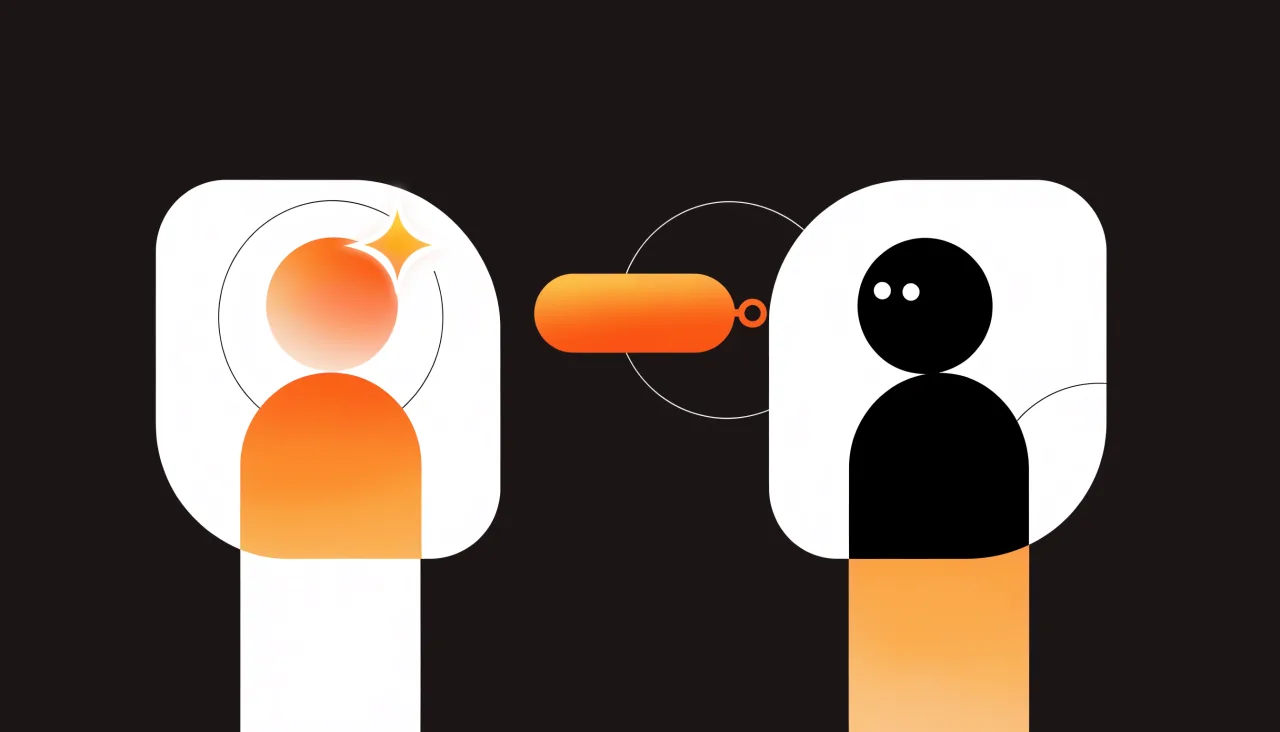
Ask people why they hate chatbots and you'll hear the same story almost word for word: they got stuck in a loop, couldn't reach a person, and gave up. The frustration is rarely about the AI answering a question — it's about the AI refusing to stop answering when it clearly should. A bot that keeps confidently restating the same unhelpful reply, with no visible exit to a human, is the fastest way to lose a customer who was ready to buy.
The fix isn't a smarter model. It's a better human handoff — knowing when to step aside, doing it cleanly, and handing back when the human is done. Get this right and the same AI customers tolerate becomes one they trust, because they can feel there's a real person behind it when it counts. This guide covers when a bot should escalate, what a clean shared-inbox handoff looks like, and the practical do's and don'ts that separate a chatbot people trust from one they rage-quit.
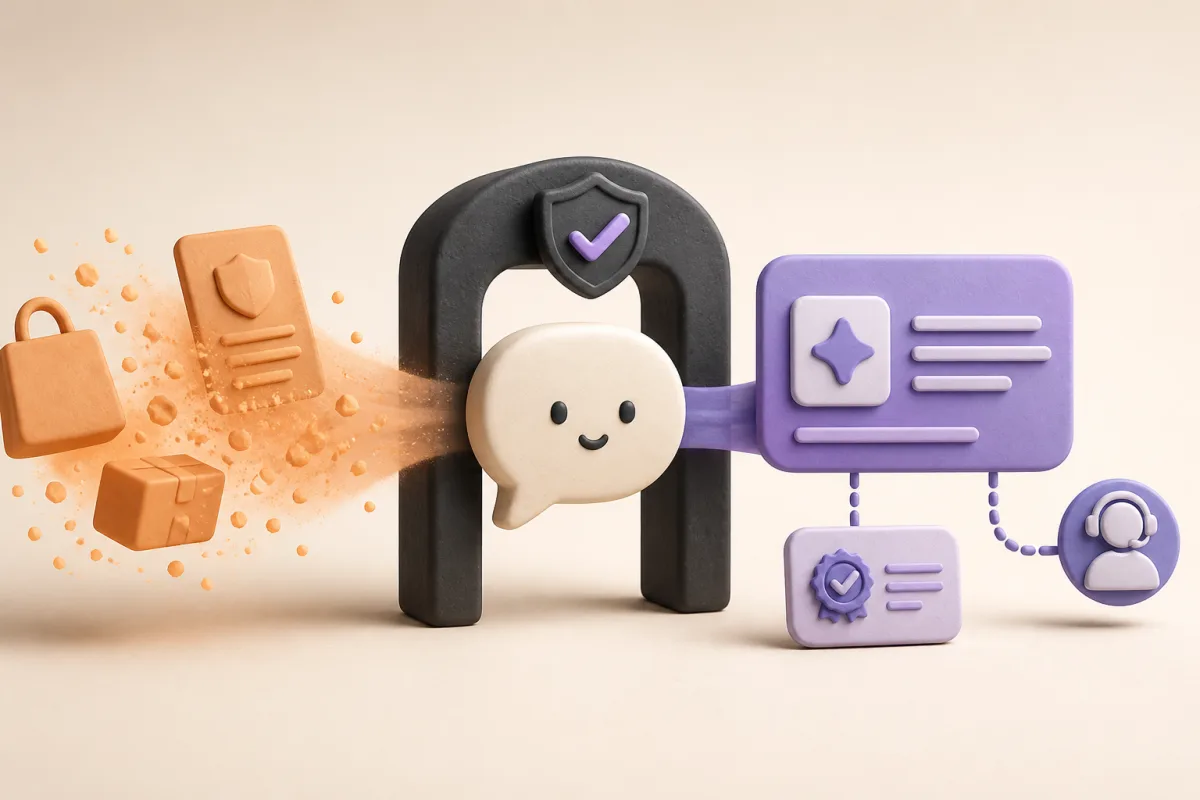
A chatbot should hand off when continuing would mean guessing — unknown answers, repeated failures, sensitive or emotional issues, out-of-scope actions, or an explicit request for a person. Done right, it's clean: the full transcript carries into a shared inbox, a teammate takes over in real time, and can hand the thread back to the bot. Off-hours, a missed handoff becomes a captured lead, never a dead end.
Quick take
- Handoff is a feature, not a failure. An agent that escalates well protects trust; one that traps people destroys it.
- Escalate on clear signals — unknown answers, sensitive issues, repeated failure, or an explicit request for a person.
- Keep the context. The human should see the full transcript so the customer never repeats themselves.
- Use a shared inbox. A teammate takes over in real time, resolves, and can return the thread to the bot.
- No dead ends. Off-hours, a missed handoff should become a captured lead, not a lost customer.
Why handoff makes or breaks AI support
It's tempting to judge an AI agent purely on how many tickets it deflects. But deflection measured in isolation rewards the wrong behaviour: a bot that never offers a human posts a beautiful deflection number while quietly torching your reputation. The customers it "deflected" didn't get helped — they left. Handoff is the safety valve that keeps automation honest.
Think of the AI's job as removing repetition, not removing people. Most of what hits your inbox is predictable: order status, sizing, return windows, "do you ship to my country?" A grounded AI agent should own the supported repeatable work so your team isn't typing the same three answers all day. The genuinely hard, emotional, or high-value conversations are exactly where a human should take over. Our live chat vs AI chatbot comparison maps those jobs explicitly. Done this way, automation and humans aren't competing; they're covering for each other.
When the bot hands off cleanly, you get faster first replies, fewer escalations that turn into complaints, and a team that spends its energy on conversations that actually need a brain. When it doesn't, you get the worst of both worlds — angry customers and a team firefighting the fallout. Handoff quality is one of the metrics that actually tell you if your agent is working, not a nice-to-have you bolt on later.
When should the bot hand off?
A good agent escalates on clear, observable signals rather than vibes. The rule of thumb: hand off when continuing would mean guessing, when the topic carries risk or emotion, or when the customer simply wants a person. Here are the triggers worth wiring up from day one:
- It doesn't know. The question falls outside the agent's grounded knowledge. A grounded bot says so and offers a human instead of inventing a returns window or a delivery date.
- Repeated failure. If the customer rephrases the same question twice, that's a signal to escalate — not to try a third confident-but-wrong answer.
- High-stakes or sensitive. Disputes, refunds beyond policy, damaged goods, account or payment problems, complaints, or anything emotionally charged.
- The customer asks for a human. Explicitly wanting a person should always work, immediately, with no friction or guilt-trip.
- Negative sentiment. Frustration, anger, or distress in the customer's wording — better to put a human in front of it early than to let a bot make it worse.
- Out-of-scope actions. Anything the agent isn't permitted to do — cancelling an order past the cut-off, applying a goodwill discount, overriding policy.
The flip side matters just as much. Escalating everything is its own failure: if the bot punts on questions it could have answered from your content, it just adds a handoff delay to problems automation was supposed to solve. The art is drawing the line cleanly.
| Hand off to a human | Keep in the bot |
|---|---|
| "This is broken / I want a refund" (beyond policy) | "What's your return window?" |
| Repeated rephrasing of the same question | A clearly worded first-time question |
| Disputes, complaints, emotional messages | Order status after identity check |
| "Can I speak to someone?" | "Do you ship to Lithuania?" |
| Requests for actions the bot can't take | Product search and recommendations |
| Anything the agent isn't confident is grounded | Anything answerable from your real content |
Most stores find that once the agent reliably handles the right-hand column — and you keep feeding it the gaps your handoff rate reveals — the volume reaching a human drops to genuinely worthwhile conversations. That's the goal: fewer tickets, but the right fewer.
How a clean handoff works
The handoff itself is where most tools fall down. The mechanics decide whether escalation feels like a seamless step up or like being thrown to the back of a queue. Here's the flow a shared-inbox handoff should follow.
The bot steps aside
When a trigger fires, the agent should hand off gracefully: acknowledge the request, set a clear expectation ("I'm bringing in a teammate"), and stop trying to answer. No loops, no "are you sure you don't want to ask me instead?" friction. In Loqara, an auto-escalation kicks in when the agent gets stuck, so customers don't have to fight their way to a person.
A human takes over from a shared inbox
The conversation lands in a shared inbox where your team can see it live. A teammate takes over the thread — at which point the bot steps back and stops replying — reads the full transcript that carried over, and answers as themselves. Because Loqara's inbox updates in real time, there's no refresh-and-hope: the agent sees new messages as they arrive and the customer sees the human reply without any awkward gap. Critically, the customer never repeats themselves, because the entire history (including what the bot already tried) is right there.
The human resolves — or hands back
When the issue is sorted, the teammate resolves the conversation. And when a human is no longer needed — say they answered the one tricky question and the rest is routine — they can return the thread to the bot, so the agent resumes handling follow-ups. Handoff isn't a one-way door; the conversation can move between AI and human as the situation needs.
No dead ends, ever
If no one is available — it's 2am, or the team is slammed — the agent shouldn't leave the customer staring at silence. Instead it captures the question and a contact detail so you can follow up, turning a missed handoff into a captured lead rather than a lost customer. The same principle holds for voice conversations: an unanswered call should still leave you something to act on.
Best practices for a handoff customers trust
- Make the human option always reachable. Never hide it to inflate deflection — customers notice, and trust collapses fast.
- Carry the full context. The human sees the whole transcript, including what the bot already tried, so nobody re-explains anything.
- Set expectations honestly. If a reply will take a few hours off-hours, say so and capture a contact detail rather than implying instant help.
- Watch your handoff rate. A little is healthy; a spike usually points to a knowledge gap worth filling, not a broken bot.
Good handoff vs bad handoff
The gap between an escalation that builds trust and one that destroys it is almost entirely in the details. Same trigger, wildly different outcomes:
A handoff that builds trust
- Bot recognises its limit and offers a human without being asked twice
- Full transcript carries over — the customer repeats nothing
- A teammate takes over in real time from a shared inbox
- The human can resolve or hand the thread back to the bot
- Off-hours, the question becomes a captured lead with a contact detail
A handoff that breaks trust
- The human option is buried to protect deflection stats
- Context is lost, so the customer re-explains from scratch
- "Someone will get back to you" — into a void, with no timeline
- The bot keeps interrupting after a human has joined
- Off-hours messages vanish with no capture and no follow-up
If you're evaluating tools, this is one of the sharpest ways to tell a real support agent from a glorified FAQ widget — and it's a question worth asking of any Gorgias, Intercom, or Tidio alternative you're comparing. Ask exactly how the bot hands over, whether context carries, and whether a human can hand back. The answers separate the serious tools from the demos. Our buyer's checklist walks through the rest of the questions that actually decide it.
Frequently asked questions
What is human handoff in an AI chatbot?
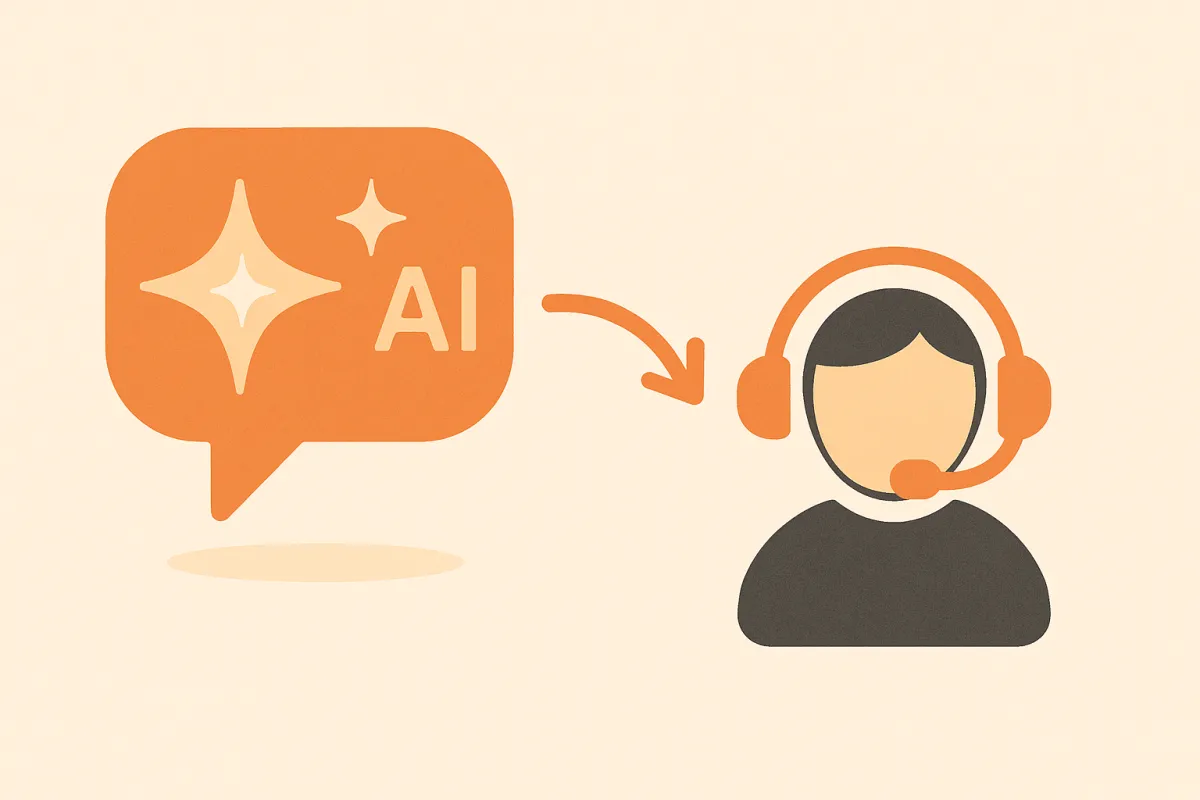
Human handoff is the moment an AI agent stops answering and routes the conversation to a real person. A good one carries the full conversation history across so the customer doesn't repeat themselves, lands the thread in a shared inbox where your team can take over, and lets the human resolve it or return the thread to the bot. It's what keeps automation from turning into a dead end.
When should an AI chatbot escalate to a human?
The bot should escalate when continuing would mean guessing, when the topic is risky or emotional, or when the customer explicitly asks for a person. Concretely: unknown or ungrounded questions, repeated failures to answer, disputes and complaints, sensitive account or payment issues, and any action the bot isn't allowed to take. An explicit request for a human should always work immediately.
Does handing off mean the AI failed?
No — a clean handoff is the agent doing its job, not failing at it. The point of automation is to remove repetitive work, not to remove people from the hard conversations where judgement matters. An agent that knows its limits and escalates gracefully protects the customer experience far better than one that bluffs its way through a question it can't answer.
What is a shared-inbox handoff?
It's a handoff where the escalated conversation appears in one inbox your whole team can see and act on, regardless of whether the customer came from chat or voice. A teammate takes over the thread in real time, the bot steps back, and the human answers with the full transcript in front of them. Loqara updates the inbox live, so there's no refreshing and no gap the customer can feel.
Can the conversation go back to the bot after a human steps in?
Yes. Handoff isn't a one-way door. In Loqara, once a teammate has handled the tricky part, they can return the thread to the bot so the agent resumes routine follow-ups. This keeps your team focused on the moments that need a human and lets automation pick the conversation back up when it doesn't.
What happens if no human is available to take the handoff?
A well-designed agent never leaves the customer hanging. If nobody can take over — off-hours or during a rush — it captures the question and a contact detail so you can follow up, turning a missed handoff into a captured lead instead of a lost customer. Watching your handoff rate over time also tells you whether a spike is a one-off or a knowledge gap worth filling.
The bottom line: human handoff isn't the part of your chatbot that admits defeat — it's the part that earns trust. An agent that answers the repetitive majority from your real content, escalates the rest on clear signals, carries full context into a shared inbox, and can hand back when the human is done gives you the best of automation and real support. The stores customers actually trust are the ones where reaching a person is easy, fast, and never feels like a fight.
Loqara includes live human handoff on every plan — a real-time shared inbox with take-over, resolve, and return-to-bot, plus auto-escalation when the agent gets stuck and full conversation context every time.
Try Loqara on your store free — one line, no credit card, live in an afternoon.