AI for e-commerce · July 23, 2026 · 12 min read
AI chatbot for furniture stores: help shoppers choose what fits

A sofa is not difficult to find because the shopper cannot type “sofa.” It is difficult because the real request sounds like this:
“I need a light-coloured sofa bed for a 2.4-metre wall, but the doorway is narrow, we have a dog, and I do not want a three-month wait.”
Ordinary category filters make the shopper translate that situation into your catalog structure. A furniture-store AI chatbot can do the translation in the other direction: understand the room and constraints, search actual products, and explain a small number of defensible options.
An AI chatbot for a furniture store helps shoppers turn room size, dimensions, material, colour, function, budget, delivery, and care needs into a useful shortlist. It works best when connected to structured, current product data, asks only questions that change the recommendation, shows the evidence behind each match, and hands uncertain or consequential cases to a person.
Quick take
- Furniture is constraint-heavy: one wrong dimension or configuration can invalidate an otherwise attractive recommendation.
- Hard rules come first: fit, function, availability, and budget should filter before style preferences rank results.
- The catalog is the expert: the AI should retrieve current facts, not invent product knowledge from model memory.
- Explain the shortlist: show why each item fits and disclose every known compromise.
- Keep visual and human help: chat complements dimension diagrams, swatches, showrooms, and specialist advice; it does not replace them.
Why is furniture shopping a good use case for conversational AI?
Furniture combines objective constraints with subjective taste. A chair can be the right colour and wrong height. A sofa can fit the wall but not the doorway. A dining table can seat six in theory while leaving too little clearance in the actual room.
The shopper may also use different language from the catalog. “Warm beige,” “easy-clean,” “not too deep,” and “something that will not dominate the room” are meaningful needs, but they may not match a filter label exactly.
This makes furniture a strong fit for conversational product recommendations:
- the shopper describes the situation naturally;
- the assistant separates hard constraints from preferences;
- it asks a small number of discriminating questions;
- it searches the current catalog and variants;
- it explains the strongest matches and missing information.
The conversation is valuable because it reduces uncertainty. It should not merely add a talking layer to the same keyword search.
Which furniture questions should the chatbot understand?
The useful questions are the ones a knowledgeable store employee would ask before recommending a product.
| Decision area | Example shopper language | What the assistant should verify |
|---|---|---|
| Physical fit | “No wider than 220 cm” | Exact width, depth, height, orientation, tolerance |
| Access | “Will it fit through an 80 cm doorway?” | Packaged dimensions, removable parts, delivery path |
| Function | “A sofa we can occasionally sleep on” | Sleeping mechanism, bed size, mattress or surface details |
| Material | “Dog-friendly and easy to clean” | Published fabric composition, care guidance, removable covers |
| Colour | “Warm beige, not grey” | Actual variant colour and swatch; avoid guessing from photography |
| Capacity | “Dining table for six” | Stated seating, dimensions, extension configuration |
| Availability | “I need it next month” | Current stock, lead time, delivery region, assembly option |
| Budget | “Under €1,500 including delivery” | Product price plus known delivery or service costs |
A strong assistant treats “must fit 220 cm” differently from “I prefer oak.” The first is an exclusion rule. The second can rank otherwise eligible products.
Why do dimensions need more than a line of text?
Dimensions are unusually consequential in furniture. Baymard Institute’s furniture and home-decor usability research found that users can struggle to connect written measurements with the corresponding part of a product; its recommendation is to provide a clear dimensions image, not only a list of measurements (Baymard, 2024).
Chat should reinforce that visual evidence, not replace it. A responsible answer can say:
- “The published overall width is 218 cm.”
- “The product page shows the chaise on the right when viewed from the front.”
- “I cannot verify the packaged width from the available data.”
- “Please measure the narrowest doorway and ask the delivery team to confirm access.”
That is safer than turning a plausible inference into a promise.
What should a good furniture recommendation conversation look like?
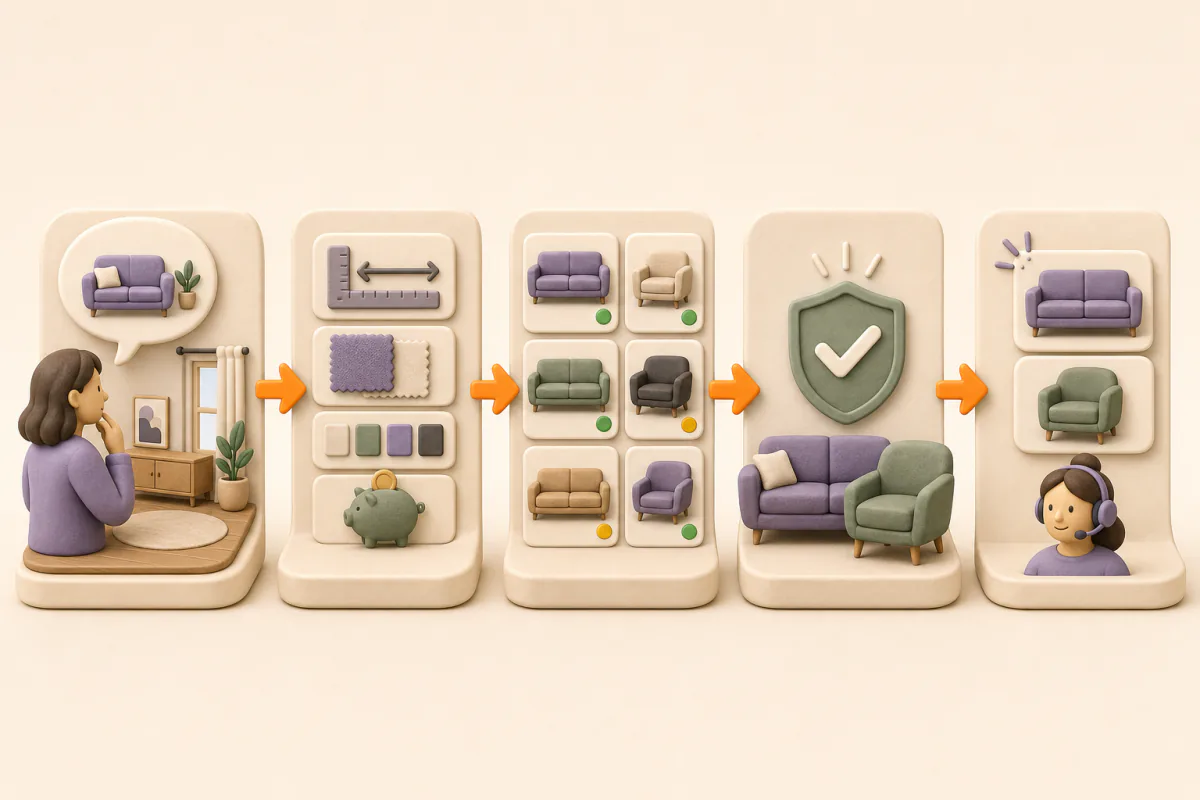
Consider a hypothetical shopper:
Shopper: “I need a sofa bed for a guest room. The wall is 235 cm, and I would prefer green fabric.”
Weak answer: “Here are our most popular green sofas.”
Useful answer: “Is 235 cm the absolute maximum width, and do you need the bed to open without moving other furniture? If you share the available floor depth, I can exclude models that fit the wall but cannot unfold.”
After the answer, the assistant should search for actual sofa beds and present perhaps two or three:
- Option A: 228 cm wide, green variant available, stated sleeping area fits the request;
- Option B: 232 cm wide and within budget, but only beige is currently available;
- Option C: attractive style match, but excluded because it is 242 cm wide.
Showing the rejected near-match can be useful when it explains why the shortlist is small. The assistant should never quietly relax a hard constraint.
What product data does a furniture AI assistant need?
The answer quality cannot exceed the catalog quality. Useful records include:
- stable product and variant identifiers;
- furniture type and collection;
- overall width, depth, and height with units;
- seat height, seat depth, arm height, and sleeping dimensions where relevant;
- orientation and configuration;
- packaged dimensions and weight;
- material, upholstery composition, finish, and care instructions;
- colour at variant level;
- current price, availability, and canonical URL;
- delivery regions, lead time, assembly, and return conditions;
- images, dimension diagrams, manuals, and warranty information.
Variant accuracy matters. Shopify, for example, manages option combinations, prices, images, and inventory at variant level, so “green” and “in stock” must refer to the same sellable variant rather than two facts borrowed from different configurations (Shopify product-variant documentation).
Normalize units without discarding the original value. If the catalog says 2,180 mm, the assistant can display 218 cm for readability, but it should preserve enough precision to avoid a rounding error near the shopper’s limit.
How should the assistant rank furniture?
Use a two-stage decision instead of one opaque relevance score.
Stage 1: eliminate hard failures
Remove products that violate a verified maximum dimension, required function, unavailable variant, delivery deadline, or absolute budget. If a required field is missing, mark it unknown rather than treating it as a pass.
Stage 2: rank the eligible products
Rank the remaining items using softer preferences such as style, colour family, material, care, room type, brand, and price position. Explain the top reasons and a meaningful trade-off for each result.
A label such as “95% match” is not evidence unless the store can explain its calculation. Plain language is usually better:
“This is the strongest verified fit because it is within the width limit, has the required sleeping function, and the selected green variant is available. The trade-off is that the product page does not publish packaged dimensions.”
Where can a furniture chatbot genuinely help the business?
Product discovery
It gives shoppers a route when category names and filters are not enough. This is especially useful for large catalogs with similar-looking models and many structured attributes.
Pre-purchase questions
The assistant can answer published questions about care, assembly, delivery, warranty, and returns while the shopper is still considering the product.
Comparison
It can place verified dimensions, materials, mechanisms, and prices side by side. A useful comparison highlights material differences rather than repeating both descriptions.
Demand insight
No-match conversations reveal requests that the current catalog or product data cannot satisfy: a missing colour, a recurring width limit, an unclear care claim, or demand for faster delivery.
Human preparation
A high-value or unusual request can reach a specialist with the room, measurements, shortlist, and unresolved question attached. That reduces repetition without pretending every furniture decision should be automated.
What should the chatbot refuse to guess?
Some answers need data or judgment the assistant may not have:
- whether a product will definitely fit through the shopper’s home;
- an exact colour match based on different screens or lighting;
- stain resistance, durability, or pet suitability without a published basis;
- comfort for a particular person;
- load capacity not stated by the manufacturer;
- a delivery date that the fulfillment system has not confirmed;
- whether a product is safe for a use outside its documented purpose.
The right response is a boundary plus a useful next step. Ask for a measurement, link the dimension diagram, identify the missing fact, offer a swatch, or involve the store team.
How do you add an AI chatbot to a furniture store?
1. Choose one high-friction furniture category
Start with a category where fit and attributes repeatedly drive questions: sofas, dining tables, mattresses, office chairs, or modular storage.
2. Audit the decision data
Take 20 representative products and try to answer real shopper questions from the stored fields alone. Missing dimensions, mixed units, generic colours, and configuration ambiguity should be fixed at the source.
3. Connect live products and approved knowledge
The assistant needs current catalog data plus delivery, assembly, care, warranty, and returns content. Loqara supports live product search for connected Shopify, WooCommerce, Magento, and Verskis stores; the exact fields available still depend on what the storefront publishes.
4. Define hard constraints and uncertainty rules
Tell the system which requirements exclude a product, which missing fields require disclosure, and which cases go to a person.
5. Test adversarial furniture requests
Include tight dimension limits, conflicting requirements, ambiguous orientation, mixed units, unavailable colours, products with missing attributes, and questions that require delivery-team confirmation. Use the broader chatbot launch test plan for privacy, knowledge, and handoff cases.
6. Launch narrowly and review
Begin with one category or part of traffic. Read conversations, inspect every displayed product, and correct source data before adding prompt exceptions.
How should a furniture store measure the result?
Track both commercial outcomes and recommendation quality.
| Metric | Why it matters |
|---|---|
| Product-card click-through | Whether the shortlist earns further consideration |
| Add-to-cart after chat | Whether guidance moves the decision forward |
| Assisted conversion | Whether conversations contribute to completed orders |
| Constraint violation rate | Whether a displayed item breaks a stated hard rule |
| No-verified-match rate | Where demand or product data has a gap |
| Clarification rate | Whether the assistant asks too much or too little |
| Human handoff rate and reason | Which questions still need expertise or permissions |
| Return reasons after assisted sales | Whether fit or expectation mistakes remain |
Do not interpret a lower handoff rate as success by itself. A safe system may hand off more high-value edge cases while resolving routine questions more reliably.
When is an AI chatbot not the right furniture investment?
It may add little if the catalog is tiny, products are highly bespoke, key facts live only in employees’ heads, availability is rarely updated, or most sales already require an in-person design consultation.
Repairing product data, adding dimension drawings, improving photography, or clarifying delivery terms may create more value first. The assistant becomes useful when it can connect those foundations to a real shopper’s situation.
Frequently asked questions
Can an AI chatbot tell whether furniture will fit in my room?
It can compare the measurements you provide with published product dimensions and flag missing clearance, orientation, or access information. It should not guarantee physical fit when doorway, stair, lift, packaging, assembly, or layout details are unknown. A dimension diagram and delivery-team confirmation remain important.
Can a furniture chatbot recommend by colour and material?
Yes, when colour and material are stored as reliable product or variant attributes. The assistant should distinguish main upholstery colour from component colours and should not infer an exact real-world shade from a photograph alone. Swatches and showroom viewing remain the better evidence for colour-sensitive purchases.
Does the chatbot know current furniture stock and prices?
Only if it is connected to a current catalog or storefront source. Price and availability should be retrieved at answer time or refreshed frequently. The assistant should disclose when a value is missing or stale rather than presenting a remembered or indexed value as current.
Can it compare several sofas or tables?
Yes. A useful comparison aligns the same verified fields—dimensions, configuration, material, function, price, availability, delivery, and care—then explains the trade-offs. It should avoid “best” claims that are not supported by the shopper’s requirements or the catalog evidence.
Will an AI furniture assistant reduce returns?
It may help prevent avoidable expectation and fit mistakes, but it cannot guarantee a lower return rate. Measure return reasons for assisted orders against a suitable comparison group. Accurate product data, dimension imagery, photography, swatches, packaging details, and clear policies all contribute to the outcome.
Can it work with Shopify, WooCommerce, Magento, or Verskis?
Loqara supports product search for connected Shopify, WooCommerce, Magento, and Verskis stores. Capability depth depends on the provider and the fields the storefront exposes. Validate representative products, variants, current availability, and detailed attributes before promising a particular recommendation workflow.
Should the chatbot replace furniture sales staff?
No. It is best used for instant discovery, repeatable product facts, and preparation. Staff remain important for comfort, design judgment, bespoke configurations, delivery access, negotiations, exceptions, and high-value decisions. A good system makes that expertise easier to reach with the relevant context already captured.
The honest bottom line: a furniture chatbot earns trust by excluding the wrong product, not by always finding something to recommend.
Try Loqara free with one furniture category, real dimensions, live product cards, and a human handoff for everything the catalog cannot prove.