AI for e-commerce · August 14, 2026 · 11 min read
AI chatbot for hardware stores: turn projects into product lists

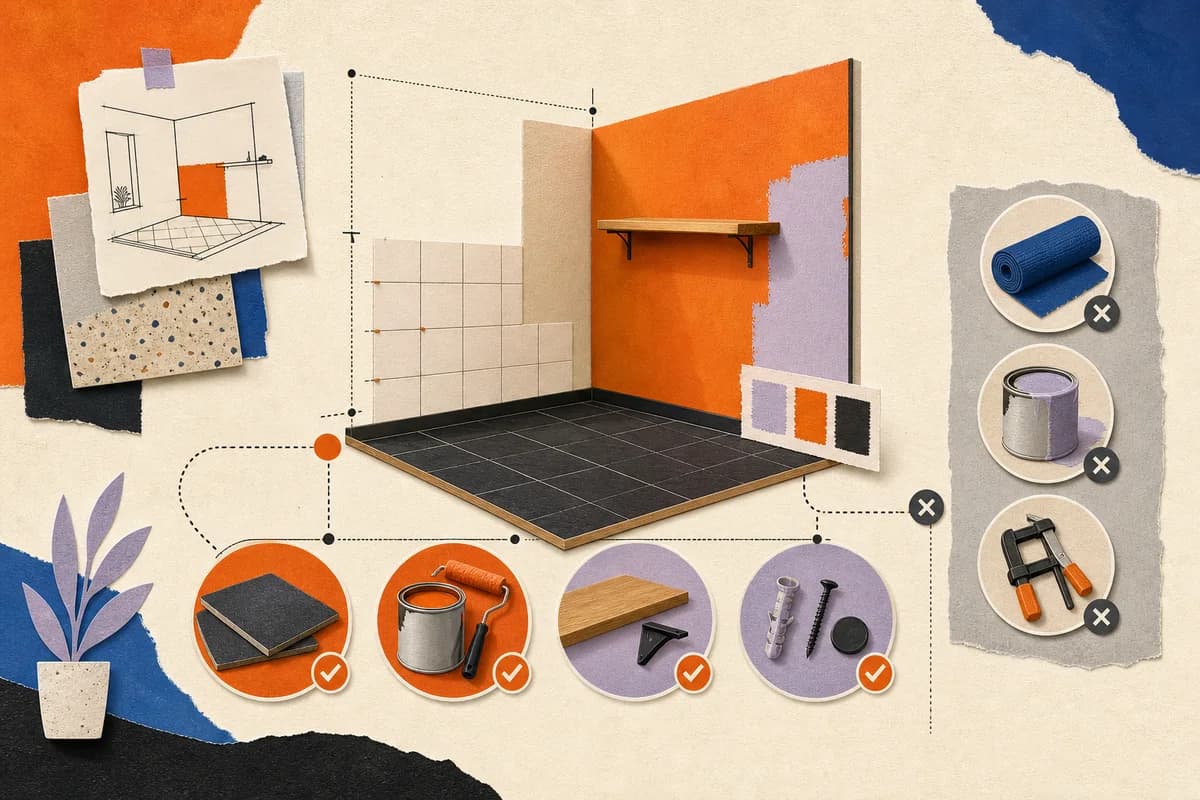
Hardware shoppers often arrive with a project rather than a product name:
“I need to tile a 2.4 by 1.8 metre utility-room floor. What do I actually need?”
That request contains dimensions, surface conditions, material choices, quantities, compatible components, tools, risk, and local installation requirements. A useful assistant can organise those facts into a transparent shopping plan. A careless one can produce a plausible list that is incomplete, incompatible, or unsafe.
An AI chatbot for a hardware store turns a clearly bounded project into verified products, quantities, compatible accessories, and open questions. It should show every measurement and assumption behind its calculation, use current product specifications, and hand electrical, gas, structural, hazardous-material, code-dependent, or otherwise risky work to a qualified person instead of improvising instructions.
Quick take
- Start with the project: “paint a bathroom” contains more useful intent than “buy paint”.
- Units and assumptions must be visible: hidden arithmetic creates expensive shortages and waste.
- Compatibility comes before bundling: every primer, fixing, blade, connector, and accessory must fit the material and main product.
- Stock is not suitability: an available item can still be wrong for the surface, environment, or task.
- Safety defines the boundary: some projects need a tradesperson, manufacturer, or local-code check.
Why do hardware shoppers search by project?
Many customers know the outcome they want but not the product taxonomy. They ask about:
- fixing a shelf to an unfamiliar wall;
- painting a damp or high-traffic room;
- laying flooring over an existing surface;
- replacing a tap, seal, handle, filter, or fitting;
- building a deck, planter, partition, or storage unit;
- choosing drill bits, blades, fasteners, adhesives, or sealants for specific materials;
- estimating enough material without buying an unreasonable surplus.
Traditional category navigation assumes the shopper already knows whether they need an anchor, plug, screw, primer, membrane, underlay, transition profile, or compatible accessory. Conversation can begin with the goal and translate it into those product concepts.
That does not mean the assistant should generate a shopping list immediately. It first needs the dimensions, substrate, environment, existing system, desired finish, skill level, and exclusions that change eligibility.
What should a project assistant ask?
Ask questions that change the calculation, compatible system, or safety route.
| Project | Decisive questions | Product evidence needed |
|---|---|---|
| Painting | Area, surface, condition, room environment, existing coating, finish | Coverage, coats, substrate compatibility, preparation |
| Tiling | Floor/wall area, tile size, substrate, wet area, joint width | Pack coverage, adhesive/grout compatibility, movement requirements |
| Flooring | Area, room shape, substrate, moisture, heating, transitions | Pack coverage, underlay, installation method, expansion guidance |
| Shelving | Wall type, load, shelf depth, bracket spacing | Fixing substrate/load data and compatible drill size |
| Plumbing replacement | Exact fitting, dimensions, thread/connection, pressure/application | Connection standard, seals, material, approved use |
| Cutting or drilling | Workpiece material, thickness, tool model, desired result | Tool interface, blade/bit type, limits, PPE guidance |
The assistant should know when the customer cannot safely identify the substrate or existing installation. “It sounds hollow” is not enough evidence for a load-bearing fixing recommendation.
How should quantity calculations work?
Use a visible formula, explicit units, and source-backed coverage.
For a rectangular 2.4 m × 1.8 m floor:
- measured area:
2.4 × 1.8 = 4.32 m²; - subtract permanently excluded areas only when the installation method justifies it;
- apply the merchant’s documented waste allowance or ask the shopper to choose one;
- divide by the exact pack coverage;
- round up to a purchasable pack quantity;
- state the resulting surplus.
If a tile pack covers 1.44 m² and the agreed allowance produces a target of 4.75 m², the result is four packs: 4 × 1.44 = 5.76 m². The answer should show that four packs cover more than the target and should not disguise the surplus.
Google’s unit-pricing specification includes flooring as a worked example and distinguishes the total product measure from the base measure used for price comparison (Google Merchant Center, unit pricing). An assistant needs both pack coverage and price context; price per pack alone does not tell the shopper how much floor it covers.
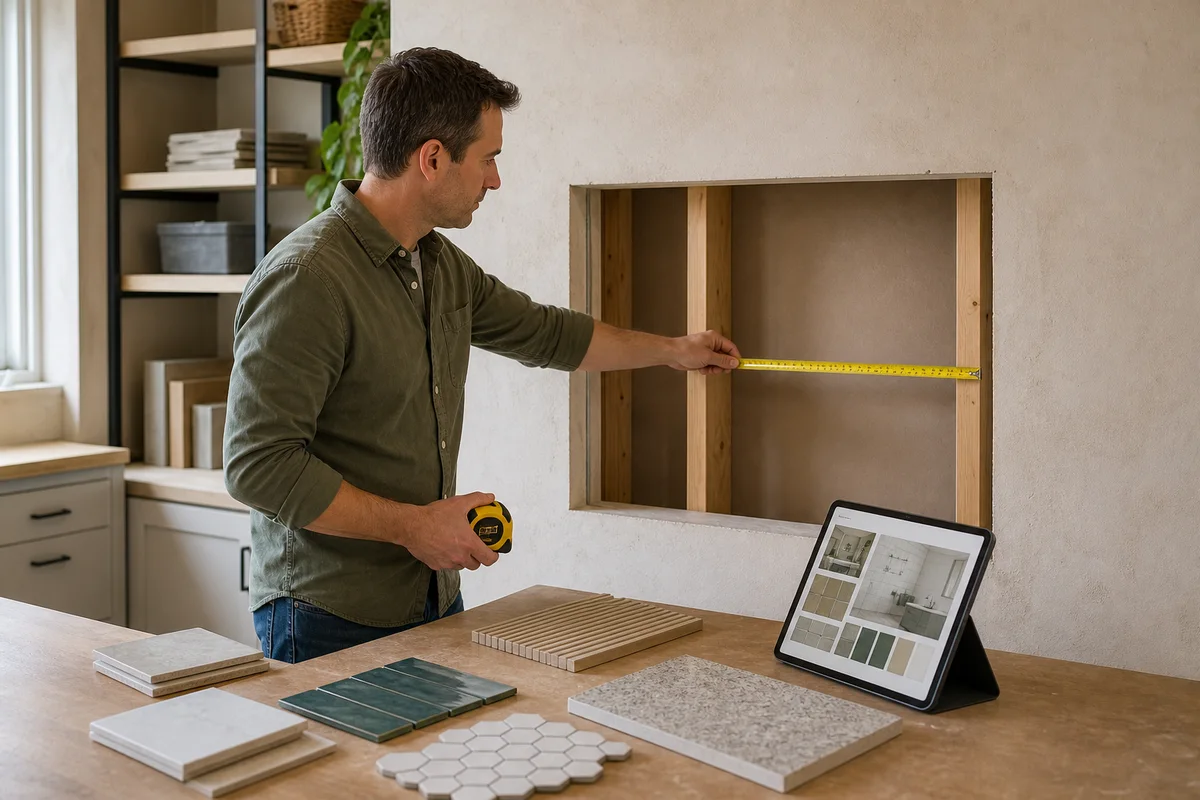
Which product facts make project recommendations reliable?
Useful hardware data often lives deeper than the title and price:
- product length, width, height, weight, volume, or coverage with units;
- pack quantity and unit-pricing measure;
- substrate, material, environment, and application compatibility;
- dimensions, connection type, thread, shank, fitting, voltage, or tool interface;
- load, pressure, temperature, moisture, indoor/outdoor, and chemical limits;
- cure, drying, working, or recoat times under stated conditions;
- required primer, underlay, seal, fastener, accessory, or companion product;
- explicitly incompatible materials or uses;
- kit contents, included quantity, and items sold separately;
- approved installation instructions, warnings, and source date;
- exact price, stock, URL, and fulfilment constraints.
Google’s product_detail field is designed for technical specifications and explicitly names package contents, installation instructions, power requirements, and feature lists as useful product-specific information. Google says these details can help discovery across AI-driven surfaces including AI Mode (Google Merchant Center, product detail).
Dimensions must also remain unambiguous. Google maps product length, width, height, and weight to structured quantitative values and recommends using consistent units (Google Merchant Center, product dimensions).
How should compatible products become a project list?
Build the list in layers:
- Primary material or item: the tile, paint, shelf, fitting, flooring, or component that satisfies the main requirement.
- Required preparation: cleaning, levelling, primer, membrane, underlay, or another documented prerequisite.
- Required installation products: adhesive, grout, fixings, connectors, blades, bits, or seals verified for the selected system.
- Tools and consumables: items needed for application, cutting, spacing, protection, or cleanup.
- Optional finish or maintenance: sealant, trim, touch-up material, cleaner, or spare quantity—clearly labelled optional.
- Open questions: substrate, local code, hidden services, moisture, load, or another unknown that blocks part of the plan.
Do not add every accessory in the category. Each item should have a reason: required by the selected product, required by the stated conditions, or a clearly optional convenience.
That restraint is also central to a good AI product recommendation chatbot: eligibility and stated constraints should shape the shortlist before popularity, margin, or basket size.
What does a trustworthy project answer look like?
Consider:
“What do I need to mount a 120 cm shelf on this wall?”
A weak assistant lists a shelf, two brackets, screws, and wall plugs.
A trustworthy assistant asks:
- What is the wall construction?
- What will the shelf hold and what is the estimated total load?
- Which shelf and bracket model are you using?
- Are there hidden pipes or cables, and has the mounting position been checked?
It may then say:
“The selected brackets publish a maximum load only when installed into the manufacturer’s specified substrate and spacing. Your wall type is still unknown, so I can show the shelf and brackets but I cannot verify fixings. Please identify the substrate or ask the store’s hardware specialist before drilling.”
The assistant has still helped: it narrowed the product family and exposed the one unknown that matters most.
Which projects require a human or qualified professional?
Use conservative routing for:
- mains electrical work;
- gas appliances, lines, fittings, or combustion ventilation;
- structural alterations or load-bearing work;
- work at height or requiring specialist access;
- asbestos, lead, mould, hazardous chemicals, or unknown materials;
- fire protection, life-safety, or regulated systems;
- pressurised, high-temperature, or high-voltage systems;
- child-safety or accessibility installations where failure creates serious harm;
- any task dependent on permits, local building code, or site inspection.
The assistant may surface the manufacturer’s approved instructions, warnings, and the store’s service route. It should not translate a shopping conversation into a claim that the customer is competent or that the work complies with local rules.
How do you add an AI chatbot to a hardware store?
1. Choose one repeatable project family
Start with paint quantities, flooring packs, basic tiling, compatible tool accessories, or another bounded workflow. Avoid launching structural, gas, and electrical advice as a generic “DIY expert”.
2. Write the decision sheet
For each project, list the inputs, formula, approved products, compatibility rules, exclusions, optional items, and professional-handoff triggers. Ask experienced staff to review it.
3. Structure measurements and units
Store values as numbers with units, not decorative prose. Distinguish product dimensions, package dimensions, coverage, unit price, quantity per pack, and quantity required for the project.
4. Connect current products and approved instructions
Loqara can search products exposed by supported connected storefronts and answer from approved knowledge. Available attributes differ by provider. Technical data sheets, project rules, compatibility tables, and installation documents may need to be added when the catalog does not expose them clearly.
5. Make calculations inspectable
Repeat the shopper’s dimensions, show the formula, state the allowance, and round only at the purchase-unit step. Ask for confirmation before using an assumption that materially changes quantity.
6. Test failure cases
Include mixed units, an L-shaped room, an unknown substrate, inconsistent pack coverage, an out-of-stock companion product, an incompatible blade, a risky project, an impossible load, and a request to ignore manufacturer guidance.
What can Loqara do—and what remains separate?
Loqara can:
- clarify a bounded project through conversational questions;
- search current products in supported connected stores;
- answer from approved specifications, guides, and policies;
- explain transparent calculations defined by the merchant;
- show products and collect unresolved questions for staff;
- hand risky or uncertain work to a person.
Loqara does not inspect a property, identify hidden services, certify a substrate, determine code compliance, replace a qualified tradesperson, or guarantee a project outcome. It does not automatically add every project item to a cart or change the store catalog unless a separate authorised workflow supports that action.
For complex trade purchases, the assistant can instead prepare the kind of structured brief described in our B2B technical-buyer qualification guide.
Which metrics matter?
| Metric | What it reveals |
|---|---|
| Project clarification completion | Whether shoppers can supply decisive inputs |
| Complete-system click rate | Whether compatible lists move the journey forward |
| Quantity correction rate | Whether customers or staff frequently revise calculations |
| Missing specification rate | Which products need better coverage, dimensions, or compatibility data |
| Companion-item rejection | Whether suggested accessories prove incompatible |
| No-safe-answer rate | How often professional routing is correctly required |
| Assisted return reason | Whether wrong quantities or incompatible items remain common |
| Unsupported-claim rate | Whether the assistant exceeds evidence; target zero |
Do not optimise for the longest basket. A smaller, correct list is better than an inflated bundle containing unnecessary or incompatible items.
Frequently asked questions
Can an AI chatbot calculate paint, tile, or flooring quantities?
Yes, when it has confirmed dimensions, units, product coverage, purchase-unit size, and an agreed allowance. It should show the formula and round up transparently. Irregular rooms, pattern layouts, defects, site conditions, and installation methods may require a person.
Can it tell me which wall fixing to use?
Only when the wall construction, load, bracket, fixing evidence, and installation conditions are known. If the substrate or hidden services are uncertain, the assistant should not guess from a description or photo.
Can it build a complete project basket?
It can prepare a list of verified primary, required, and optional products. Whether it can create a cart depends on the connected commerce workflow. Every companion item should remain individually compatible and available.
Does it replace advice from store staff or a tradesperson?
No. It can handle repeatable product questions and transparent calculations. Novel site conditions, safety risk, regulated work, contradictory evidence, or professional judgement should reach qualified help.
Can it use a photo of the room or damaged part?
A photo can supply context and help the shopper explain the project. It does not reliably reveal hidden construction, exact dimensions, material condition, services, or code requirements. Confirm consequential facts separately.
Will it always recommend products?
No. “I cannot verify the substrate”, “the required companion item is unavailable”, or “this needs a qualified professional” can be the correct outcome. Measure decision quality rather than forced product output.
The honest bottom line: a hardware assistant should make the assumptions smaller and the evidence clearer before it makes the basket bigger.
Try Loqara free with one repeatable project family, structured specifications, and a staff route for every condition the website cannot inspect.