AI for e-commerce · July 25, 2026 · 11 min read
AI chatbot for B2B e-commerce: qualify technical buyers before sales

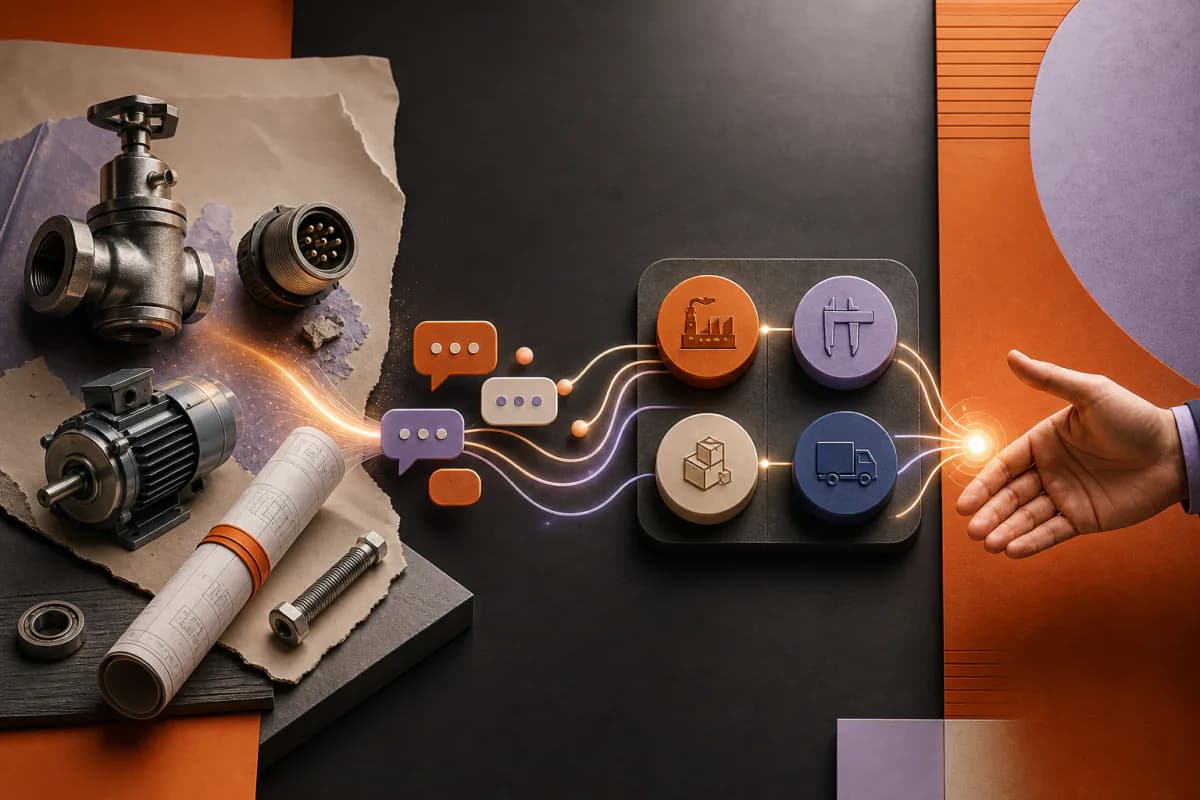
The highest-value B2B visitor may not type “book a demo.” They may ask:
“We need a food-safe pump for a viscous product, around 40 litres per minute, delivered to Kaunas before the line shutdown.”
That is not a routine lead and not yet a complete quote request. It is a technical buying problem containing an application, constraints, risk, quantity, location, and deadline. A B2B e-commerce AI chatbot can turn that first message into a useful brief—without pretending it can replace engineering, pricing authority, or a commercial relationship.
A B2B e-commerce AI chatbot qualifies technical buyers by capturing the application, required specifications, quantity, location, deadline, account context, and unresolved risks. It can search approved products and documents, then hand a structured brief to sales or engineering. It should not invent suitability, negotiate terms, or issue a binding quote.
Quick take
- Qualify the problem, not just the person: an email address without the application and constraints is a weak lead.
- Self-service and expertise can coexist: let buyers research immediately, then preserve a fast specialist route.
- Ask discriminating questions: every question should change eligibility, risk, routing, or commercial priority.
- Keep systems authoritative: account price, stock, lead time, credit, and order terms require current sources and permissions.
- Make the handoff useful: send the specialist what the buyer already explained, not a notification that says “new chat.”
Why is B2B qualification different from consumer lead capture?
A consumer inquiry may be resolved by budget, size, colour, and delivery. A technical B2B purchase can involve:
- an application or process environment;
- mandatory dimensions, materials, tolerances, certifications, or standards;
- expected load, flow, temperature, duty cycle, or volume;
- integration with existing equipment;
- sample, drawing, data-sheet, or compatibility requirements;
- quantity and repeat demand;
- target delivery date and destination;
- account pricing, credit, tax, purchase orders, and approval roles;
- engineering or compliance review.
Shopify’s current B2B guidance emphasizes self-service alongside customer-specific catalogs, pricing, inventory, quote building, repeat orders, and integration with operational systems (Shopify, 2026). That complexity is why a generic “name, company, email” form is rarely enough.
The chatbot’s job is not to close every deal. It is to reduce the distance between an imprecise first question and the right next action.
What should a B2B chatbot ask a technical buyer?
Start with the smallest set of questions that changes the result.
| Qualification area | Example question | Why it matters |
|---|---|---|
| Application | “What will the component do in your process?” | Establishes the real job and vocabulary |
| Existing system | “What equipment or interface must it work with?” | Reveals compatibility and integration constraints |
| Required specification | “Which values are mandatory, and which are preferred?” | Separates exclusions from ranking preferences |
| Environment | “What temperature, material, washdown, outdoor, or hazardous conditions apply?” | Identifies risk and specialist routing |
| Quantity | “Is this one replacement, a pilot, or a recurring volume?” | Changes stock, pricing, and sales priority |
| Location and deadline | “Where is it needed, and by what date?” | Affects availability, shipping, and feasibility |
| Evidence | “Do you have a part number, drawing, photo, or data sheet?” | Gives the specialist a verifiable starting point |
| Contact route | “Who should receive the response, and is email or phone better?” | Enables a consented follow-up |
Do not ask all eight areas in every conversation. A returning buyer with a part number may need two questions. A new application may need several. Progressive qualification is better than recreating a long form one bubble at a time.
How should the assistant separate requirements from preferences?
Technical buying fails when a “nice to have” and a hard requirement are treated equally.
Consider:
“We prefer stainless steel, need food-contact documentation, and cannot exceed 300 mm overall length.”
The assistant should represent:
- documented food-contact suitability: required;
- maximum length: required;
- stainless steel: preference unless the buyer confirms it is mandatory.
If no product satisfies every hard constraint, the response should not quietly relax one. It can say:
“I found no item whose published data confirms both the documentation and maximum length. Two products meet one requirement, but I have excluded them from a verified shortlist. I can send the specification to an applications specialist.”
That answer protects the buyer and creates a higher-quality opportunity.

What information should reach the sales or engineering team?
The handoff brief should be readable in seconds:
- Buyer and organization: only the contact and account facts the buyer provided or the authenticated system supplies.
- Application summary: the buyer’s goal in plain language.
- Hard constraints: exact values, units, standards, dates, and exclusions.
- Preferences: brand, material, budget, or configuration choices that can flex.
- Candidate products: items retrieved from current data and why they may fit.
- Unverified points: missing fields, contradictory sources, or claims requiring specialist review.
- Attachments and sources: drawings, photos, data sheets, product URLs, and the relevant conversation.
- Next requested action: confirm suitability, prepare a quote, check lead time, recommend an alternative, or call the buyer.
The original wording should remain available. Summaries are useful, but they can omit nuance. A specialist should be able to inspect what the buyer actually said.
The transfer itself should follow a deliberate human-handoff workflow: name the destination, preserve the transcript and evidence, and tell the buyer what response to expect next.
Which B2B tasks can AI handle—and which need authority?
| Task | AI can help | Human or connected system remains authoritative |
|---|---|---|
| Understand unfamiliar buyer language | Map terms to catalog concepts and ask clarifying questions | Specialist resolves ambiguous or novel applications |
| Find likely products | Search structured catalog and approved documents | Engineering confirms consequential suitability |
| Compare published specifications | Align the same verified fields and disclose gaps | Specialist interprets exceptions and combined-system behavior |
| Capture a quote request | Collect requirements, contact details, and consent | Authorized staff or quoting system issues the quote |
| Show account pricing | Display only from an authenticated, current source | Commerce or ERP rules determine price and eligibility |
| Check availability | Retrieve current stock or lead-time data when connected | Operations confirms bespoke production and exceptional dates |
| Discuss terms | Explain published payment, delivery, or return policies | Staff negotiates deviations, credit, contracts, and liability |
| Create an order | Prepare context or a cart where supported | Authorized workflow validates price, tax, approvals, and payment |
The distinction is permissions, not intelligence. A language model can phrase a confident number without having authority to bind the company to it.
What does Loqara support for B2B stores?
Loqara can:
- answer from approved product, policy, and technical content;
- search current products in supported connected commerce platforms;
- collect lead details during a conversation;
- preserve the buyer’s request for human follow-up;
- support a live human handoff.
Loqara does not, by default:
- certify that a product is suitable for a technical application;
- generate account-specific prices from an ERP it cannot access;
- issue a binding quotation;
- approve credit, negotiate terms, or sign agreements;
- create a purchase order on the buyer’s behalf;
- promise custom production or delivery dates.
Those capabilities require the relevant system integration, business rules, authentication, permissions, and human authority. State that boundary before launch, not after the first difficult inquiry.
How do you build a B2B qualification flow?
1. Choose one buying journey
Start with replacement parts, specification-led product discovery, sample requests, repeat-order help, or quote qualification. Avoid a single flow that tries to cover every department.
For consumer-facing merchants, a similarly narrow workflow can turn a measured job into a transparent materials list. The hardware-store project assistant guide covers quantity calculations, compatible product systems, and the point where safety questions need a professional.
2. Interview the people who qualify requests today
Ask sales engineers and customer-service staff which missing facts force another email. Their real checklist is more useful than a generic lead-scoring template.
3. Prepare structured product and application data
Include stable identifiers, aliases, specifications with units, certifications, drawings, exclusions, compatible systems, current URLs, and source dates. Semantic product search helps with unfamiliar language, but hard constraints still need structured values.
4. Define routing rules
Route by product family, geography, account, application risk, revenue potential, language, or urgency. Safety-sensitive and novel applications should reach an expert even when a likely product exists.
5. Protect commercial and personal data
Do not ask for confidential drawings, personal information, or regulated data unless the workflow is designed to receive and protect it. Explain why contact details are needed and how the business will use them.
6. Test incomplete and adversarial requests
Include mixed units, impossible deadlines, contradictory specifications, no valid product, unsupported standards, anonymous competitors, price requests without authentication, and attempts to make the bot promise suitability.
7. Review handoff quality
Ask the receiving team whether the brief saved time and what was missing. Improve questions and source data, not just the wording of the summary.
How should B2B chatbot leads be scored?
Use operational evidence, not a mysterious AI “intent score.”
Signals can include:
- a clearly defined application;
- mandatory specifications provided;
- a valid product family or part number;
- quantity or recurring demand;
- a realistic deadline and destination;
- account or organization identified;
- contact permission;
- a concrete next action requested;
- specialist review required.
Do not mistake verbosity for value. A concise repeat order from an authenticated customer may deserve immediate attention. A long academic question may not represent a purchase.
Which metrics matter?
| Metric | What it tells you |
|---|---|
| Qualified handoff rate | How often conversation produces an actionable brief |
| Required-field completion | Where buyers abandon or questions are unclear |
| Time to first specialist response | Whether routing actually accelerates follow-up |
| Repeated-question rate | Whether staff must ask for the same facts again |
| Accepted-opportunity rate | Whether sales agrees the leads are relevant |
| Quote conversion | Whether qualified conversations reach a commercial outcome |
| No-match and data-gap rate | Which products or applications need better content |
| Incorrect promise rate | Whether the assistant exceeded its evidence or authority |
The best early success metric may be simple: “Did the specialist understand the request without restarting it?”
Frequently asked questions
Can a B2B chatbot qualify leads without asking for an email first?
Yes. It can begin by answering the buyer’s question and clarifying the application. Ask for contact details when a follow-up, quote, file delivery, or specialist response requires them. This creates value before requesting identity.
Can it recommend technical products?
It can shortlist products whose published specifications meet the stated constraints and explain the evidence. It should not certify fitness for an application when environmental, system, safety, regulatory, or engineering factors remain unresolved.
Can the chatbot show negotiated account prices?
Only through an authenticated connection to the authoritative pricing source and with the correct account permissions. A public knowledge base or remembered conversation is not a safe source for customer-specific price.
Can it prepare a request for quote?
Yes. It can collect application, specifications, quantity, destination, deadline, contact details, files, and questions. An authorized person or quoting system should validate feasibility, price, tax, delivery, terms, and validity before issuing the quote.
Should it replace a B2B sales engineer?
No. It is most useful for immediate research, routine product facts, qualification, and context capture. Specialists remain essential for novel applications, technical judgment, exceptions, negotiation, and relationship-sensitive decisions.
Does this work for repeat customers?
Yes, and the flow should be shorter. With appropriate authentication and integrations, known account context can reduce repetition. The assistant should still verify the exact part, quantity, destination, and required date rather than assume the previous order is unchanged.
Can Loqara integrate with our ERP or quoting system?
Loqara’s standard commerce connections focus on supported storefront product search and conversational workflows. A specific ERP, CPQ, account catalog, or quote integration requires technical review and should not be assumed. Until connected and tested, keep those systems authoritative through a human handoff.
The honest bottom line: B2B chat earns its place when it makes the expert conversation start further ahead—not when it tries to impersonate the expert.
Try Loqara free with one technical buying journey, a short qualification brief, and a named specialist route for every decision that requires authority.