AI customer support · July 25, 2026 · 10 min read
How AI chatbots prevent avoidable returns before the label is printed

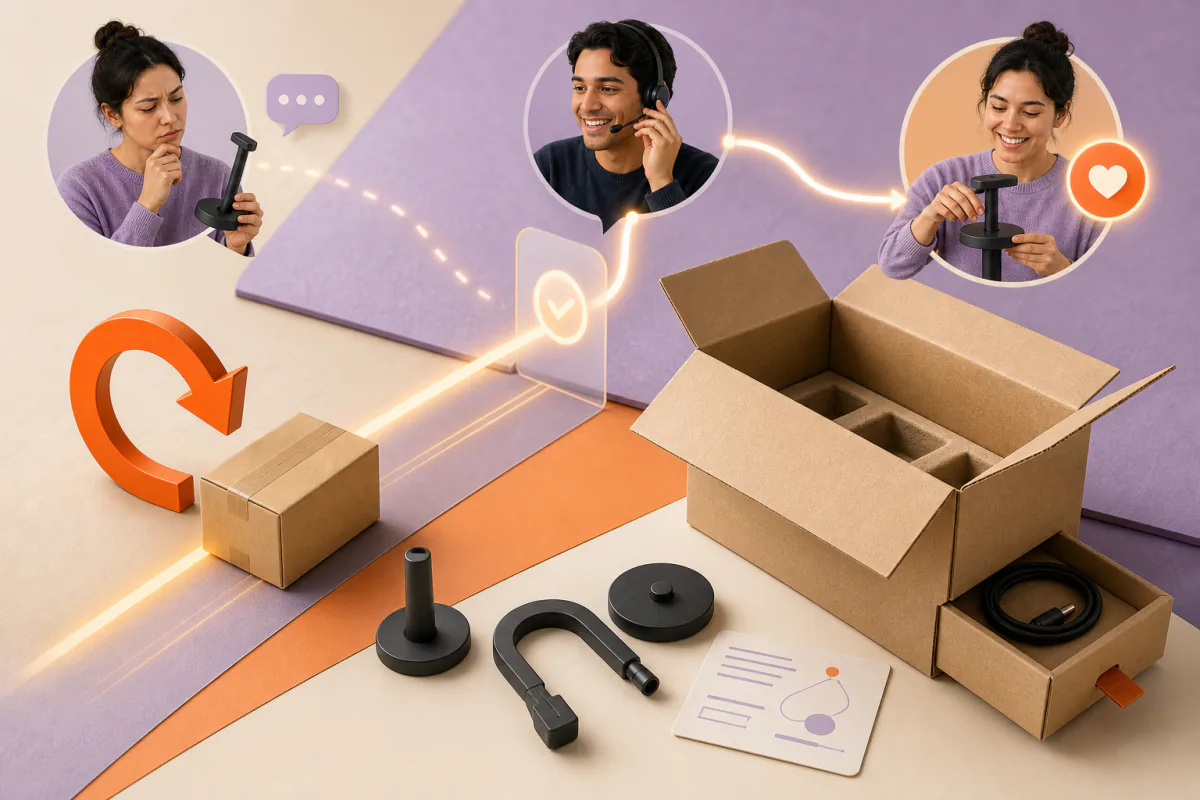
Some return requests are final: the item is damaged, the size is wrong, the product is unsuitable, or the customer simply wants to use the published return policy.
Others begin with a solvable sentence:
“It does not work.”
The cable may be in a hidden compartment. A transit lock may still be engaged. The customer may have selected the wrong input, missed one assembly step, or expected a feature the product never claimed. A pre-return AI chatbot can make approved help available at that moment—without turning support into an obstacle course.
An AI chatbot can prevent avoidable returns by identifying the product and issue, checking order and product facts where available, and offering a few approved troubleshooting steps for setup, missing parts, compatibility, or expectations. It must keep the normal return route visible, stop when safety or damage is involved, and never deny a valid return.
Quick take
- Troubleshoot before processing, not instead of processing: customers must retain a clear path to the published return policy.
- Use the exact product and variant: generic advice can create more frustration or risk.
- Keep it short: one or two likely checks are better than a twenty-step manual.
- Stop on risk: damage, heat, smoke, swelling, exposed wiring, leakage, injury, or uncertainty belongs with approved safety guidance and people.
- Learn from reasons: recurring “user error” can reveal weak instructions, packaging, product content, or design.
How is return prevention different from return automation?
Return automation helps after the customer has decided to return: explain policy, collect details, determine the correct route, and hand off or start an authorized workflow.
Return prevention happens one step earlier. It asks:
“Is the product genuinely unwanted or unsuitable, or is there a specific problem we can resolve now?”
The distinction matters. The assistant should not try to “save” every order. It should offer relevant help once, respect the customer’s choice, and proceed to the normal return path when requested.
Why is pre-return help worth improving?
The scale is material. The US National Retail Federation estimated that 19.3% of online sales would be returned in 2025, while 82% of consumers considered free returns important when shopping online (NRF, 2025).
That does not mean 19.3% of returns are preventable. Defects, fit, changed minds, delayed delivery, damage, and many other valid reasons remain. The useful opportunity is narrower:
- setup confusion;
- a part overlooked in packaging;
- an assembly step misunderstood;
- the wrong mode, input, account, or setting;
- a compatibility question that can be verified;
- a feature or included-item expectation that product content can clarify;
- a known issue with an approved resolution.
Improving product information and analyzing return reasons are established ways to reduce avoidable returns (Shopify, 2026). Conversation adds a just-in-time route to that same information.
Which return reasons are appropriate for troubleshooting?
| Customer says | Useful first response | When to stop |
|---|---|---|
| “A part is missing” | Check the exact package contents and hidden compartments | Packing list confirms it is absent |
| “It will not turn on” | Surface the approved initial setup and power checks | Damage, heat, smell, battery issue, or failed safe checks |
| “It does not connect” | Verify exact model, supported connection, and approved pairing steps | Compatibility is not published or hardware may be faulty |
| “Assembly does not fit” | Confirm model, orientation, part labels, and relevant diagram | Force, modification, instability, or injury risk |
| “It is smaller than expected” | Confirm published dimensions and intended use | Expectation is accurate but product is unsuitable |
| “I received the wrong item” | Verify order and product identifiers where connected | Mismatch is confirmed |
| “I changed my mind” | Explain the normal return route | Immediately; no troubleshooting needed |
Never use a troubleshooting flow to argue with the customer’s stated experience. “The dimensions were on the page” is not support. If expectations repeatedly differ, the product page needs improvement.

What should a good pre-return conversation look like?
Imagine a customer says:
“The lamp arrived but it does not charge. I want to send it back.”
A poor response posts the entire manual or insists on ten checks before revealing the return link.
A useful response might be:
“I can help with the return. If you want, there are two quick checks for this exact model: the charging cable is packed beneath the cardboard insert, and the first charge uses the rear port rather than the accessory port. Would you like those steps, or should I take you straight to the return instructions?”
If the customer chooses help, give one step at a time and confirm the outcome. If it fails, continue to the return route or a person. The design preserves agency.
What data does the assistant need?
Pre-return troubleshooting requires more than a generic FAQ:
- order line item and variant where authenticated and supported;
- stable product identifiers and model aliases;
- package contents and where each item is packed;
- current setup and assembly instructions;
- approved troubleshooting trees;
- compatibility and system requirements;
- known issues with source dates and affected versions;
- warranty, return, and exchange policy;
- safety stop conditions;
- support and escalation routes;
- product images, diagrams, and manual links.
Instructions should be versioned. Advice for an older model or packaging revision may be wrong for the current item.
The AI-ready knowledge-base guide explains how to separate stable help from dynamic facts and keep sources current.
How should the AI choose troubleshooting steps?
Use a constrained decision tree:
- Identify the exact product and variant.
- Classify the symptom in the customer’s words.
- Check for a safety stop or obvious policy route.
- Retrieve the approved step for that product and symptom.
- Offer the smallest useful action.
- Ask whether it resolved the issue.
- Continue, hand off, or return—without looping.
The assistant should not synthesize novel repair advice from scattered sources. If the approved content does not cover the exact case, say so.
Where should troubleshooting stop immediately?
Stop automated troubleshooting when the customer reports or shows:
- smoke, sparks, unusual heat, burning smell, swelling, leakage, or exposed wiring;
- broken safety equipment or structural instability;
- injury, allergic reaction, contamination, or possible poisoning;
- water ingress into an electrical product;
- a damaged battery or power supply;
- a child-safety concern;
- a product recall or suspected counterfeit;
- instructions requiring disassembly, bypassing a guard, or specialist tools;
- uncertainty about whether the next step is safe.
Use the manufacturer’s approved safety language and escalation route. Do not improvise emergency, medical, electrical, mechanical, or chemical advice.
What can Loqara do in this workflow?
Loqara can:
- answer from the store’s approved product, setup, package-content, and policy sources;
- search current products in supported connected stores;
- ask clarifying questions and collect issue details;
- offer a live human handoff;
- preserve conversation context for follow-up.
Loqara does not, by default:
- inspect or diagnose a physical product;
- decide whether a customer is legally or contractually entitled to a return;
- approve a return, exchange, warranty claim, refund, or exception;
- create a carrier label or issue money without an authorized integration;
- invent repair or safety instructions;
- force troubleshooting before showing the store’s return route.
This scope should be reflected in both the conversation and the store’s operational process.
How do you launch pre-return troubleshooting?
1. Use return-reason data
Group recent reasons by product and symptom. Shopify introduced more category-specific return reasons in 2026 to make patterns easier to identify (Shopify Changelog, 2026). Conversation labels should map to the same operational categories where practical.
2. Pick one low-risk, high-volume problem
Good starting points include overlooked accessories, initial setup, account pairing, orientation, or published compatibility. Avoid safety-sensitive repair.
3. Write the shortest approved resolution
Use clear steps, diagrams, exact model scope, stop conditions, and a visible return or human-help option.
4. Connect the exact item where possible
An authenticated order lookup or user-selected product reduces ambiguity. If the assistant cannot verify the item, ask for the model rather than assuming.
5. Test every exit
Test resolved, unresolved, unsafe, damaged, wrong-item, changed-mind, policy-exception, and “just show me the return instructions” paths.
6. Review conversations and fix upstream causes
If many customers miss the same cable, redesign the insert or add a visible package-content card. If everyone misunderstands a dimension, repair the product page. Chat should reveal friction, not normalize it.
How do you measure return prevention honestly?
| Metric | Why it matters |
|---|---|
| Offered-help acceptance | Whether customers consider the intervention relevant |
| Confirmed resolution | Whether the customer says the issue is solved |
| Return initiated after help | Whether the resolution persists |
| Repeat-contact rate | Whether “resolved” actually deferred the problem |
| Troubleshooting abandonment | Whether the flow is too long or frustrating |
| Safety-stop accuracy | Whether risk cases leave automation correctly |
| Return-route visibility | Whether customers can still exercise the policy |
| Product-level recurring reason | Which page, package, instruction, or product needs fixing |
Avoid claiming a “saved return” merely because a label was not created in the same session. The customer may return later or contact another channel. Use a defined observation window and compare similar orders.
What should never count as success?
Do not celebrate:
- hiding the return link;
- exhausting the customer until they leave;
- persuading someone to keep a defective or unsuitable product;
- sending unapproved repair instructions;
- closing a conversation without confirmation;
- denying policy rights through chat;
- reducing refunds while complaints and chargebacks rise.
The business outcome and the customer outcome must align. A genuinely resolved problem is a win. Friction is not.
Frequently asked questions
Can an AI chatbot stop customers from returning products?
It should not try to stop them. It can offer relevant, optional help when a problem may be solvable, then preserve the normal return route. Customers with defects, wrong items, unsuitable products, changed minds, or unresolved issues should reach the store’s published process.
Which products are best for pre-return troubleshooting?
Products with repeatable, low-risk setup or assembly issues and clear model-specific documentation are good candidates. Avoid automated repair for safety-sensitive electrical, battery, medical, chemical, protective, or structurally consequential products.
Can the chatbot see what the customer ordered?
Only when the platform and authorized integration support order lookup and the customer is properly verified. Otherwise, ask the customer to select or identify the exact product and variant. Never expose order details from an unverified identifier.
Can it issue a refund or return label?
Not by default. Those actions require a connected, authorized returns or commerce workflow with business rules and customer verification. Without that integration, the assistant can explain policy, collect context, and hand the case to the correct team.
How many troubleshooting steps should it offer?
Start with one or two high-probability, low-effort, approved checks. Ask whether each helped. Provide the return or human route immediately when requested and set a hard limit so the customer cannot become trapped in a loop.
Will this reduce my return rate?
It may reduce returns caused by setup confusion, overlooked parts, verified compatibility questions, and misunderstood expectations. Measure by product and reason against a comparison group. It will not eliminate defects, fit problems, delivery damage, or valid preference-based returns.
Is preventing returns the same as improving product pages?
No, but they reinforce each other. Product pages prevent uncertainty before purchase; chat helps at the moment a customer is stuck. Recurring conversations should feed improvements to content, packaging, instructions, quality control, and product design.
The honest bottom line: return prevention is good service only when the product problem is genuinely resolved and the customer’s right to return remains easy to use.
Try Loqara free with one low-risk troubleshooting case, approved steps, and an immediate return or human-help exit.