Vendor comparisons · July 23, 2026 · 11 min read
Shopify Inbox vs AI chatbot: when is the free option enough?


Shopify Inbox is a sensible first chat tool for many Shopify stores. It is native, easy to install, and lets a merchant talk to shoppers without buying a separate helpdesk.
The question is not whether an AI chatbot has a longer feature list. It is whether your customers need a job that Inbox does not already perform well enough.
Shopify Inbox is enough when a store mainly needs native live chat, staff replies, prepared instant answers, product and discount sharing, and Shopify’s built-in order-tracking answer. Choose a dedicated AI chatbot when shoppers need open-ended grounded answers, conversational product discovery, broader automation, voice, or a hybrid AI-to-human workflow that operates beyond predefined questions.
Quick take
- Start with the customer job: native live messaging and an autonomous AI agent are not the same product.
- Inbox has a strong free-app case: it covers human chat and useful Shopify-native actions without another software subscription.
- Its instant answers are controlled: merchants publish predefined questions and answers; Shopify Magic can suggest drafts.
- Dedicated AI earns its cost through depth: open questions, live catalog reasoning, multi-source knowledge, voice, and routing.
- Do not replace what works: keep Inbox if it solves the actual workload reliably.
Review scope and commercial interest
Reviewed 23 July 2026 using Shopify’s public product and Help Center documentation; this was desk research, not a logged-in feature test. Loqara sells a paid AI chat product, so it benefits commercially if a reader chooses dedicated AI. The recommendation below therefore starts with cases where Shopify Inbox is the better answer.
What is Shopify Inbox?
Shopify describes Inbox as a mailbox for online-store chat. Staff can reply from the web or mobile apps, manage conversations, and send product links, discount codes, and images. Shopify currently limits availability to stores on Basic, Grow, Advanced, and Plus plans (Shopify Help Center).
Shopify promotes the Inbox app as free to add. The store still needs an eligible paid Shopify plan (Shopify Inbox product page).
Important capabilities include:
- online-store live chat;
- desktop, iOS, and Android access;
- staff conversation management;
- product, image, and discount-code sharing;
- quick replies for repeated messages;
- scheduled availability and automated first replies;
- predefined instant answers;
- a default “Track my order” instant answer;
- AI-suggested instant-answer drafts and suggested replies through Shopify Magic.
That is already a useful support setup. A small store with manageable chat volume should not buy another tool merely because “AI” sounds more advanced.
Is Shopify Inbox already an AI chatbot?
It includes AI-assisted features, but the operating model described in Shopify’s help documentation is different from an open-ended autonomous support agent.
For instant answers, the merchant creates a visible question and the answer that appears when a shopper selects it. Shopify Magic can suggest questions and draft answers from store policies and conversation history, but the merchant reviews and publishes them. Automatically generated instant-answer suggestions are currently English-only (Shopify instant answers).
Shopify Magic also supports suggested replies in Inbox (Shopify Magic). This helps a person answer faster. It does not mean every free-text customer question will be autonomously researched across the catalog and approved knowledge.
The distinction is:
- AI-assisted live chat: AI helps prepare or suggest the response; a person or predefined answer remains central.
- AI chatbot or agent: the system interprets an open-ended question, retrieves approved facts or live products, produces an answer, and escalates when it cannot act safely.
Neither model is universally better.
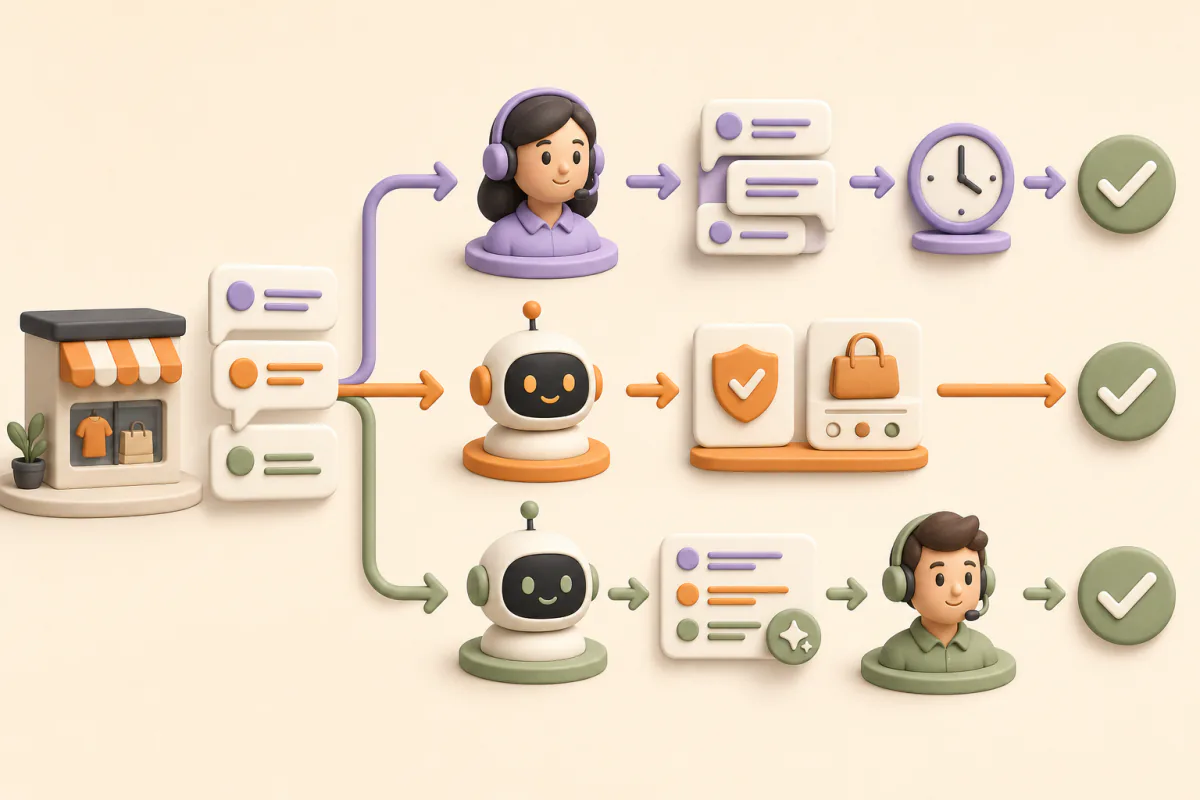
Shopify Inbox vs AI chatbot: the practical comparison
“Dedicated AI chatbot” is a category, not one feature set. The comparison below describes a grounded commerce assistant such as Loqara; verify any specific vendor independently.
| Decision | Shopify Inbox | Dedicated grounded AI chatbot |
|---|---|---|
| Extra app cost | Shopify markets the app as free; eligible Shopify plan required | Usually a separate subscription or usage charge |
| Human live chat | Core strength | Depends on the product; should include or connect a handoff |
| Predefined FAQs | Instant answers and quick replies | Can answer open-ended variations from approved knowledge |
| AI drafting | Shopify Magic suggestions | Usually generates the customer-facing answer directly |
| Product sharing | Staff can send product links | Can search and explain products when connected to live catalog data |
| Product discovery | Human-led conversation | Can interpret needs, ask follow-ups, and rank verified matches |
| Order tracking | Native default “Track my order” instant answer | Varies by vendor and integration; verify identity controls |
| Availability messages | Configurable hours and first replies | Can answer supported questions continuously, with handoff expectations |
| Voice | Not described as a core Inbox storefront feature | Available from some specialist vendors, often as an add-on |
| Other platforms | Shopify only | Some products support multiple commerce platforms and websites |
| Control model | Staff plus merchant-published answers | Knowledge, tools, permissions, guardrails, testing, and review |
The “winner” changes row by row. Inbox has a particularly strong advantage for native human chat and Shopify-native order tracking without another app subscription. Dedicated AI has an advantage when the store needs to interpret and resolve many open-ended questions before a person joins.
When is Shopify Inbox enough?
Your team can answer the volume
If messages arrive at a manageable rate and staff can respond within the expectation set in the widget, live chat may be all you need. Inbox lets you configure availability and different automatic first replies for available and unavailable hours (Shopify availability settings).
Most self-service questions fit predefined answers
Returns, shipping, contact details, and order tracking may fit a small list of well-written instant answers. Controlled answers are a strength when the policy is simple and the shopper can recognize the right question.
Conversations benefit from a person
Custom products, unusual discounts, sensitive complaints, or nuanced styling advice may justify a human from the beginning. AI is not automatically more efficient if most conversations require judgment.
You are still learning what customers ask
Inbox provides a low-commitment way to collect real questions. Review the conversation history before deciding which jobs are frequent and stable enough to automate.
A second system would create more operational work than it removes
Every AI chatbot needs knowledge ownership, testing, permissions, monitoring, and escalation rules. If no one will maintain those foundations, a simpler native setup is safer.
When does a dedicated AI chatbot become useful?
Shoppers ask the same intent in many different ways
A predefined question works when the customer selects it. An AI agent becomes more useful when shoppers type varied requests such as “Can I send this back after trying it?”, “What if the size is wrong?”, and “How long do I have to return an unused item?” The agent can map those forms to the same approved policy.
Product discovery is part of support
Inbox lets staff share products. A commerce-focused AI assistant can instead turn “a waterproof daypack under €100 for a 15-inch laptop” into constraints, search current products, and explain a shortlist. That is the intent covered by our AI product recommendation chatbot guide.
Customers need answers outside staffed hours
An automated first reply sets expectations; it does not resolve an open-ended question. A grounded AI agent can answer supported product and policy questions immediately, then capture or hand off everything else.
Knowledge lives in more than a few instant answers
Stores may have policies, product details, manuals, delivery pages, sizing guidance, and technical documentation. A retrieval-based agent can search the relevant source rather than asking the merchant to encode every question manually.
You want one model across more than Shopify
A merchant with several storefronts or a separate content site may prefer a platform-independent assistant. Check integration depth rather than assuming every connector exposes the same product, order, and customer actions.
Voice or multilingual operation matters
Some specialist tools add voice and broader language handling. Verify the exact language, speech, and handoff support. Loqara’s current voice experience supports English and Lithuanian and is a paid add-on; it should not be presented as universal-language voice.
Can you use Shopify Inbox and an AI chatbot together?
Yes, but avoid placing two competing launchers in the same corner of the store.
Possible operating models include:
- Inbox only: shopper starts a live conversation with staff and can select instant answers.
- AI first, human handoff inside the AI product: one surface answers supported questions and transfers the thread to a person.
- AI for product discovery, Inbox for staff messaging: possible, but the UI must make each role obvious and avoid duplicated notifications.
- Inbox during staffed campaigns, AI at other times: feasible if the handoff and availability state are reliably coordinated.
The cleanest experience is usually one visible conversation surface. The shopper should not need to understand your software stack.
What should a Shopify merchant test before choosing?
Use 20 to 30 real messages, not vendor demo questions.
Test Shopify Inbox against:
- a shopper selecting each instant answer;
- a free-text question not represented in the list;
- an order-tracking request;
- a product question requiring staff to search;
- an after-hours message;
- two staff members managing the same queue;
- a conversation moving from quick reply to nuanced advice.
Test an AI chatbot against:
- paraphrases of the same policy question;
- missing, conflicting, and outdated knowledge;
- current product price and availability;
- a request with several hard product constraints;
- an unsupported order or account action;
- personal-data requests and identity verification;
- angry, ambiguous, and high-value conversations;
- human handoff without repetition.
Record accuracy, time to useful answer, shopper effort, human time, unresolved rate, and business outcomes. Do not score a confident wrong answer as faster service.
What does Loqara add—and where is Shopify Inbox stronger?
Loqara provides grounded AI chat, approved knowledge retrieval, live Shopify product search, conversational recommendations, live human handoff, analytics, and optional English/Lithuanian voice. It can also be embedded on non-Shopify sites and supports other commerce providers.
Current boundary: Loqara does not provide Shopify order lookup today. Shopify Inbox’s native “Track my order” instant answer is therefore the stronger choice for that specific Shopify job. Loqara order lookup is available only on supported integrations and requires identity verification.
Inbox is also the more direct answer when a merchant primarily wants staff-operated chat at no additional app charge. Loqara becomes relevant when the store has enough repeatable open-ended work or product-discovery demand to justify a maintained AI system.
Frequently asked questions
Is Shopify Inbox free?
Shopify markets the Inbox app as free to add, but the store needs an eligible Shopify plan. Shopify’s current help documentation lists Basic, Grow, Advanced, and Shopify Plus. Plans and feature availability can change, so confirm the current requirement in Shopify before making a purchasing decision.
Does Shopify Inbox automatically answer customer questions?
It supports instant answers that the merchant creates and publishes, including a default order-tracking answer. Shopify Magic can suggest instant-answer content and replies. That is different from assuming every open-ended message receives an autonomous, grounded answer without staff or predefined content.
Does Shopify Inbox have live chat?
Yes. Online-store shoppers can start a conversation, and staff can respond from the web, iOS, or Android. Merchants can configure availability, automatic first replies, appearance, pre-chat forms, instant answers, and staff workflows.
Can Shopify Inbox recommend products?
Staff can see customer context and share product links during a conversation. A dedicated commerce AI chatbot goes further when it independently interprets a need, searches current catalog data, asks follow-up questions, and explains why a small set of products fits.
Can Shopify Inbox track orders?
Shopify documents a default “Track my order” instant answer that automatically provides order status when selected. This is a meaningful native advantage. A third-party AI chatbot’s order capability varies by vendor and integration; verify identity checks, supported actions, and data handling.
Should a new Shopify store start with Inbox or AI?
Inbox is usually the lower-risk starting point when chat volume is small and the team can answer messages. Use those conversations to identify repeatable jobs. Add dedicated AI only when the expected customer and operational value justifies knowledge maintenance, testing, and another subscription.
Is Loqara a replacement for Shopify Inbox?
Not necessarily. Loqara fits stores that want grounded open-ended answers, live product discovery, human handoff, analytics, and optional voice. Shopify Inbox is stronger for native staff chat and Shopify’s built-in order-tracking answer. The right choice depends on the workload rather than a blanket replacement claim.
The honest bottom line: if Shopify Inbox already handles the workload reliably, keep it. Add dedicated AI only for a customer job you can name, test, and measure.
Try Loqara free with real Shopify product questions before deciding whether the extra automation earns its place.