AI for e-commerce · October 19, 2026 · 14 min read
AI chatbot for home appliance stores: fit, delivery, and installation

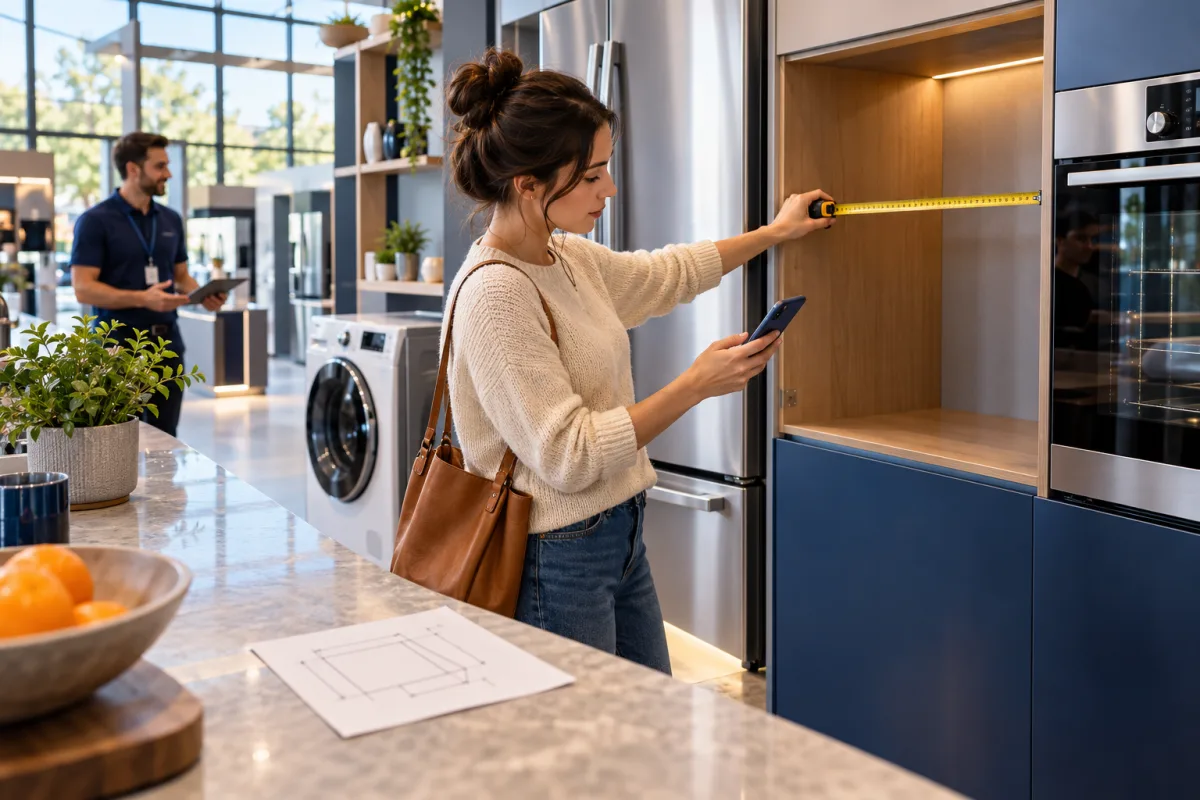
A shopper buying a washing machine, refrigerator, oven, or dishwasher is not choosing only a product. They are choosing something that must fit a space, pass through a doorway, connect to the available utilities, meet household needs, arrive safely, and work with the installation plan.
A useful appliance assistant turns those hidden constraints into a checked buying decision. A reckless one turns a plausible recommendation into a failed delivery, unsafe connection, or costly return.
An AI chatbot for a home appliance store should verify the installation type, exact product and space dimensions, clearance and ventilation, power and utility requirements, delivery access, capacity, energy-label facts, included parts, warranty terms, and current stock. It must surface unknowns and route electrical, gas, plumbing, structural, or site-specific decisions to qualified help.
Quick take
- “60 cm” is not a fit guarantee: product dimensions, recess size, door swing, hoses, ventilation, and service clearance are different measurements.
- Installation type comes first: freestanding, built-in, integrated, under-counter, and stackable products have different constraints.
- Energy facts need a source: use the exact model’s official label and product information sheet where applicable.
- Delivery is part of compatibility: stairs, lifts, doorways, turns, parking, unpacking, and old-appliance removal can decide the order.
- Safety is a hard boundary: the chatbot should never improvise gas, mains electrical, plumbing, structural, or ventilation approval.
Why are home-appliance questions difficult?
Large appliances combine product choice with site compatibility.
A refrigerator may fit the visible opening but lack room for hinges or ventilation. A washing machine may match the width but conflict with the drain position. An oven may share a nominal size with the old model but require a different electrical supply or cabinet recess. A tumble dryer may have the desired capacity but exceed the delivery route’s narrowest turn.
The customer often supplies an outcome rather than a specification:
“I need a quiet dishwasher for an open-plan kitchen.”
That request still leaves decisive questions:
- freestanding, semi-integrated, or fully integrated?
- available width, height, depth, and leveling tolerance?
- cabinet-panel dimensions and hinge system?
- inlet, drain, socket, and shutoff positions?
- household size and typical load?
- acceptable program duration and noise level?
- delivery postcode, access, installation, and old-machine removal?
Conversation is useful because the assistant can ask only the next question that changes eligibility. It is dangerous when the interface sounds certain before those facts are known.
What should an appliance chatbot ask first?
Use a category-specific decision sheet rather than one universal questionnaire.
| Appliance | Decisive questions | Evidence needed |
|---|---|---|
| Refrigerator/freezer | Freestanding or integrated, space and access dimensions, hinge/door swing, ventilation, capacity, water connection | Product and recess dimensions, clearances, climate class, connection requirements, installation guide |
| Washing machine | Space, load capacity, freestanding or built-in, inlet/drain, floor/site, spin noise, stacking plan | Dimensions, hose reach, connection and stacking requirements, official specifications |
| Tumble dryer | Dryer type, drainage/condensate plan, ventilation where applicable, load, stacking | Product dimensions, installation method, energy label, approved stacking kit |
| Dishwasher | Width, integrated style, cabinet panel, inlet/drain, place settings, noise | Recess and door-panel requirements, connection diagram, program and energy data |
| Oven or hob | Built-in dimensions, supply type, electrical/gas requirements, ventilation, compatible cabinet | Installation manual, power/load data, cut-out dimensions, qualified-installer requirements |
| Cooker hood | Mounting type, hob width, extraction or recirculation, duct route, room/site constraints | Airflow/noise data, duct dimensions, clearance and installation instructions |
The assistant should collect measurements in a consistent unit and repeat them back. “About 60 cm” is a lead, not an installation specification.
How should the chatbot verify whether an appliance fits?
Use four separate checks.
1. Product-body dimensions
These describe the appliance itself. Confirm whether handles, doors, hinges, feet, protruding connections, and packaging are included.
2. Required opening or recess
Built-in appliances usually have installation dimensions that differ from the product body. Use the manufacturer’s installation drawing for the exact model, not a category average.
3. Operating clearance
Doors, drawers, detergent compartments, filters, ventilation, heat dissipation, hoses, plugs, and service access need room. A product that physically enters the space may still be unusable.
4. Delivery route
Measure the narrowest relevant doorway, lift, staircase, landing, and turn. Confirm packaging dimensions when delivery occurs boxed, plus weight and handling constraints.
A reliable answer might say:
“The appliance body is listed as 595 mm wide, but I cannot confirm installation from that number alone. The manufacturer specifies the recess, ventilation, and connection clearances separately. Please provide the opening width, height, and depth and confirm where the socket, inlet, and drain sit.”
That answer is more commercially useful than “Yes, it is a 60 cm model,” because it prevents a false fit decision.
Which product facts should the store structure?
For each model, collect facts that can be traced to a current source:
- brand, exact model identifier, SKU, and variant;
- freestanding, built-in, integrated, under-counter, countertop, or stackable type;
- product, package, recess, cut-out, and door-panel dimensions with units;
- net and packaged weight;
- hinge, door-swing, reversible-door, and handle details;
- ventilation, heat, clearance, and service-access requirements;
- voltage, frequency, power, current, plug, circuit, gas, water, drainage, or duct requirements;
- hose and cable lengths where published;
- approved stacking kits, panels, filters, conversion kits, connectors, and other accessories;
- capacity and the exact way it is measured;
- noise values and operating condition;
- energy class, consumption, water use, program duration, and other label facts where regulated;
- included parts versus items sold separately;
- delivery, installation, removal, recycling, and haul-away services by location;
- warranty term, exclusions, service region, and claim route;
- live price, availability, fulfillment estimate, and product URL;
- installation manual, energy label, and product information sheet source URLs.
Do not merge product dimensions with packaged dimensions or appliance width with required cabinet width. Store them as separate fields.
How should energy labels be explained?
Energy information is useful only when it is tied to the exact model, product group, test basis, and market.
In the European Union, many appliance categories covered by energy-labelling rules use an energy label and a Product Information Sheet. The European Commission says online dealers must display the required label and product information for products within scope, and EPREL provides official model information generated from supplier registrations (European Commission, dealers; EPREL labels and product sheets).
The chatbot can explain:
- the exact model’s efficiency class;
- the consumption basis shown on that label;
- water, capacity, duration, noise, or other category-specific values;
- why two labels from different product groups should not be compared as if they measure the same thing;
- that real household use varies with program, load, settings, environment, maintenance, and behavior.
It should not calculate a guaranteed bill reduction from an energy class alone. If the merchant offers a cost illustration, show the formula, local tariff assumption, usage assumption, label value, and limitations.
Energy labels and rules differ by market. A global store must route each shopper to the applicable local model documentation rather than reuse one region’s label everywhere.
How can a chatbot compare appliances without oversimplifying?
First eliminate models that fail hard constraints. Then compare trade-offs among the eligible products.
A useful comparison table might align:
| Decision | Model A | Model B | Why it matters |
|---|---|---|---|
| Installation type | Fully integrated | Freestanding | Different cabinet and door requirements |
| Required opening | Verified from manual | Verified from manual | Determines physical eligibility |
| Capacity | Published value | Published value | Should match household use, not “bigger is always better” |
| Noise | Published value and test scope | Published value and test scope | Important near living or sleeping spaces |
| Energy information | Exact current label | Exact current label | Compare like with like in the same product group |
| Included parts | Listed items | Listed items | Prevents an installation surprise |
| Delivery/install service | Available for postcode | Delivery only | Changes the true purchase experience |
| Warranty route | Merchant/manufacturer terms | Merchant/manufacturer terms | Clarifies post-purchase support |
Only after compatibility should the assistant consider softer preferences such as finish, interface, smart features, program design, or brand preference.
This follows the same principle as a trustworthy AI product recommendation chatbot: eligibility before ranking, evidence before persuasion.
What should happen when the customer does not know?
Unknowns should become explicit next steps.
If the shopper does not know the recess depth, ask for a measurement. If they cannot identify the electrical supply, do not infer it from the old appliance’s appearance. If they do not know whether a hood can be ducted outside, show recirculation-compatible options as a separate path and route the site question to an installer.
Photos can help the shopper explain a layout, but they do not reliably prove dimensions, wiring, plumbing, ventilation, structural support, gas compliance, or hidden obstructions. Use an image as context—not certification.
Good responses include:
- “I can shortlist models, but fit remains unverified until we have all three opening dimensions.”
- “This model requires the manufacturer’s approved stacking kit; I cannot confirm a third-party kit from the current data.”
- “The product page lists installation service for this postcode, but the installer must approve the site.”
- “I cannot determine circuit suitability. Please have a qualified electrician verify the supply against the installation manual.”
How can an appliance chatbot reduce avoidable returns?
It can prevent expectation and compatibility errors before checkout:
- wrong installation type;
- confusion between body and recess dimensions;
- overlooked door swing or ventilation;
- missing inlet, drain, duct, or approved accessory;
- capacity misunderstood from a generic headline;
- energy label attached to another variant or region;
- delivery service unavailable at the postcode;
- product cannot pass through the delivery route;
- old-appliance removal assumed but not purchased;
- “installation included” interpreted more broadly than the service terms.
After purchase, it can surface approved preparation steps: clear the route, disconnect only where the service permits, retain required fittings, confirm access, and have an authorized adult present. It can also provide manufacturer-approved setup help.
It should never make a legitimate return harder. Our guide to preventing avoidable returns with AI explains how optional troubleshooting can help without blocking the normal policy route.
Which questions require a human or qualified professional?
Escalate questions involving:
- mains wiring, circuit capacity, outlet location, hardwiring, or electrical alterations;
- gas type, pressure, connection, combustion, or ventilation;
- plumbing alterations, leaks, pressure, drainage, or waste connections;
- structural supports, cabinetry alteration, wall mounting, or cut-outs;
- duct routes, fire barriers, shared ventilation, or unknown voids;
- stacking combinations not explicitly approved by the manufacturer;
- site access that may require lifting equipment, door removal, or property modification;
- installation in bathrooms, mobile homes, commercial premises, or other special environments;
- conflicting manuals, damaged products, missing identification, recalls, or safety notices;
- warranty coverage that depends on inspection, installation quality, or local law.
The assistant may quote or summarize the approved manual and arrange contact. It should not certify the property, the installer, or the completed work.
How do you add an AI chatbot to a home-appliance store?
1. Start with one appliance family
Choose dishwashers, laundry, refrigeration, or another category with repeatable questions. Do not launch every installation workflow at once.
2. Build the decision sheet
Ask experienced sales and installation staff which facts eliminate a model, which only change preference, and which require a site check.
3. Normalize the product data
Separate body, packaged, recess, cut-out, door-panel, hose, cable, clearance, and delivery dimensions. Preserve units and model-specific source URLs.
4. Connect live products and approved knowledge
Loqara can search product catalogs exposed by supported Shopify, WooCommerce, Magento, and Verskis stores and answer from approved knowledge sources. The product attributes available depend on the provider. Installation manuals, energy information, delivery rules, warranty details, and compatibility tables may need to be added as governed knowledge when the catalog does not expose them clearly.
5. Define blocked-answer rules
Require a source for fit, utilities, safety, energy, compatibility, warranty, and included-part claims. When a required fact is unknown, state it and offer the next safe action.
6. Test realistic failures
Include:
- a space two millimeters too narrow;
- body dimensions that fit but a recess requirement that does not;
- an integrated appliance without panel measurements;
- a plug or utility mismatch;
- a stacking request using unapproved models;
- an out-of-stock approved accessory;
- delivery access narrower than the package;
- a model number from another region;
- a shopper asking for an energy-cost guarantee;
- a request for DIY gas or mains-electrical instructions.
What can Loqara do—and what remains separate?
Loqara can:
- ask category-specific clarification questions;
- search current products in supported connected stores;
- answer from approved specifications, manuals, policies, and service information;
- compare verified product facts;
- show relevant products, capture leads, and hand the conversation to staff;
- use voice as an optional interface for shoppers measuring a space or checking a model label.
Loqara does not inspect the site, measure the opening, verify hidden utilities, certify an installation, provide regulated professional advice, determine legal warranty rights, or guarantee fit from incomplete information. It does not currently provide Shopify order lookup; that capability is limited to supported WooCommerce and Magento stores.
Which metrics show whether it works?
| Metric | What it reveals |
|---|---|
| Clarification completion | Whether shoppers can supply the decisive facts |
| Verified-fit rate | How often exact evidence supports the recommendation |
| Unknown-required-field rate | Which categories or products need better data |
| Install-service handoff | Whether site-dependent questions reach the right team |
| Access or delivery issue rate | Whether logistics are checked before purchase |
| Compatibility-related return rate | Whether assisted orders still fail on fit or connection |
| Unsupported-claim rate | Whether answers exceed approved sources; target zero |
| Product click and lead rate | Whether verified guidance moves the purchase forward |
Do not optimize for the number of products recommended. One verified model—or a clear “measure this first”—is better than a confident list of incompatible appliances.
Frequently asked questions
Can an AI chatbot tell me whether an appliance will fit?
It can compare exact product, recess, clearance, door, and delivery dimensions from approved sources with measurements the shopper provides. It cannot verify that the measurements are correct, detect hidden obstacles, or approve the installation site.
Can it compare energy efficiency and running costs?
It can explain the exact model’s official label and product information, and it can show a transparent cost illustration using stated usage and tariff assumptions. It should not promise a particular bill reduction because real use and energy prices vary.
Can it recommend the right stacking kit or installation accessory?
Yes, when the manufacturer or merchant provides an explicit compatibility relationship for the exact models. If the relationship is missing or contradictory, the assistant should not substitute a visually similar or generic part.
Can an appliance chatbot provide installation instructions?
It can surface the manufacturer’s approved preparation and installation documentation. Electrical, gas, plumbing, structural, ventilation, and site-specific work should follow the manufacturer’s rules and be handled by a qualified person where required.
Can it check whether delivery and installation are available?
It can use the store’s current service rules and postcode or region data when those are available. Final service acceptance may still depend on access, site conditions, installer inspection, local restrictions, and separately purchased services.
Will it reduce appliance returns?
It may reduce returns caused by wrong dimensions, installation type, missing connections, misunderstood capacity, unavailable service, or incompatible accessories. It cannot prevent defects, transit damage, changed minds, incorrect customer measurements, or site conditions the store could not inspect.
How is this different from an electronics-store chatbot?
Electronics guidance often centers on exact device models, ports, protocols, power delivery, firmware, and accessory compatibility. Home appliances add installation recesses, ventilation, utilities, delivery access, energy labels, installation services, and site-dependent professional work. The workflows overlap, but the decisive evidence is different.
The honest bottom line: a home-appliance assistant should make the installation and delivery constraints visible before it makes the product persuasive.
Try Loqara free with one appliance family, exact model documentation, and a specialist route for every site condition the storefront cannot verify.