AI customer support · July 23, 2026 · 12 min read
Live chat vs AI chatbot for e-commerce: which should your store use?


A store does not need to choose between “humans who care” and “automation that scales.” That framing hides the operational question:
Which customer jobs are repeatable enough for AI, which need human judgment, and how should the conversation move between them?
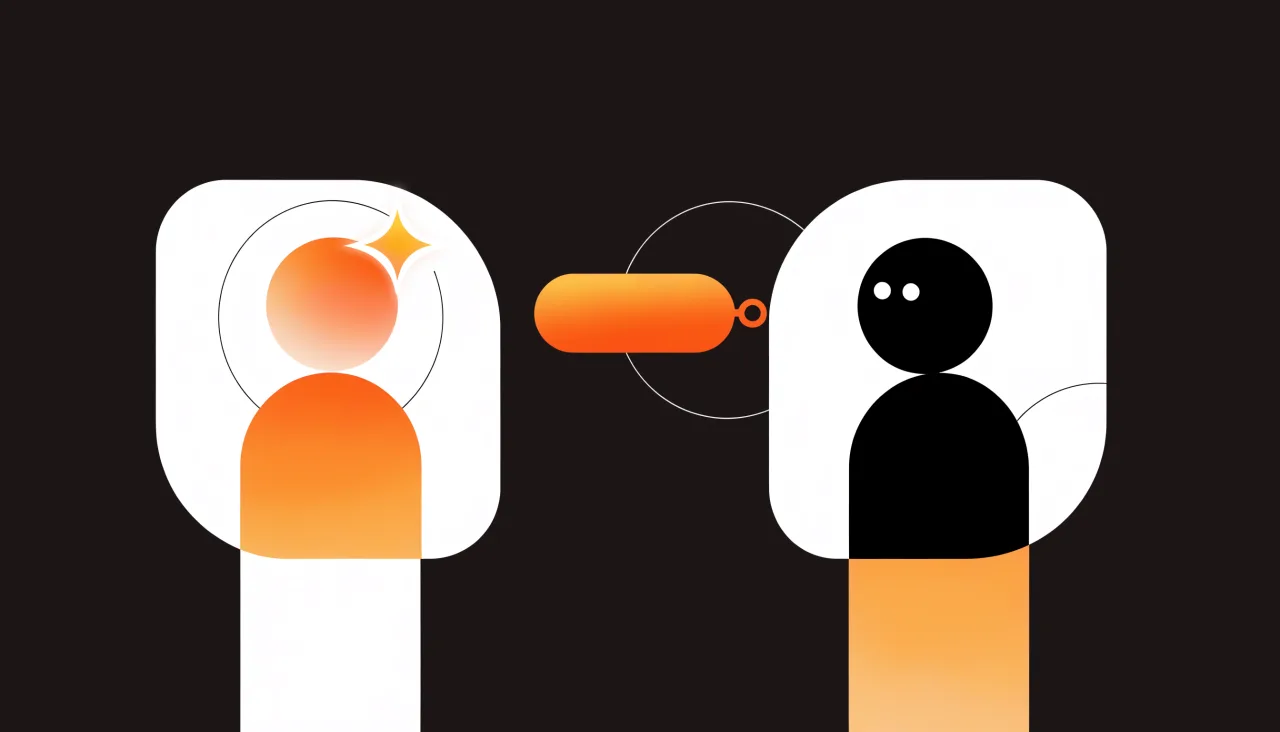
Live chat and AI chatbots can occupy the same chat window while doing very different work.
Language can change that division of labour: AI may extend repetitive coverage in supported languages, while a human handles nuance and exceptions. Use the multilingual AI support checklist to test language coverage instead of assuming a model's language list applies to the complete support flow.
Use live chat when a shopper needs judgment, negotiation, empathy, account-sensitive action, or an exception. Use an AI chatbot for repeatable questions, approved product and policy facts, catalog discovery, and immediate first-line help. Most growing e-commerce stores benefit from a hybrid: AI handles verified routine work, then transfers the conversation and context to a person.
Quick take
- Live chat is a channel: a person communicates synchronously with the shopper.
- An AI chatbot is an operating system for repeatable conversation: it retrieves, reasons, answers, and routes within defined boundaries.
- Speed is not enough: an instant wrong answer is a service failure.
- Hybrid usually wins: automate stable facts and preserve human ownership of exceptions.
- Measure outcomes: resolution, accuracy, effort, conversion, and handoff quality matter more than message volume.
What is the difference between live chat and an AI chatbot?
Live chat connects a shopper to a person through a website messaging interface. The software may provide saved replies, queue management, customer context, and AI drafting, but a human owns the conversation.
An AI chatbot interprets the message and generates the customer-facing response. A dependable commerce chatbot retrieves approved store knowledge or live product data, follows permissions, exposes uncertainty, and escalates when the job falls outside its scope.
The interface may look identical. The difference is who—or what—is responsible for the answer.
This is also different from the technology definitions in our conversational AI vs chatbot guide. Here, the decision is operational: staffing, risk, coverage, and customer experience.
Live chat vs AI chatbot: which is better for each job?
| Customer job | Live chat | AI chatbot | Best default |
|---|---|---|---|
| Simple policy question | Accurate if staff knows the policy; may involve waiting | Instant when grounded in approved policy | AI |
| Product discovery | Strong human judgment; slower to search a large catalog | Scales natural-language constraints across connected products | AI first, human for nuance |
| Order status | Staff can verify and inspect exceptions | Efficient only with supported, identity-checked integration | AI for routine lookup; human for exceptions |
| Complaint or emotional conversation | Can acknowledge impact and exercise judgment | Can triage but should not imitate authority it lacks | Human |
| Discount negotiation | Human can consider value and policy | Should not invent or negotiate without explicit permission | Human |
| Technical product compatibility | Specialist can inspect edge cases | Useful when precise compatibility data exists | AI first, specialist when uncertain |
| Return-policy explanation | Human can interpret unusual circumstances | Good for the published rule | AI for rule; human for exception |
| Bespoke or high-value sale | Relationship and judgment matter | Can qualify the need and prepare context | Human, AI-assisted |
| After-hours first response | Requires staffing | Available for supported questions | AI |
| Sensitive account change | Human still needs verification and authority | Only with narrow, secure action design | Usually human |
“AI first” does not mean “AI must finish.” It means the system attempts the part it can verify and recognizes the boundary early.
When is live chat the better choice?
The answer requires discretion
A delayed wedding order, a damaged high-value item, a loyal customer asking for an exception, or a complex B2B quote is not just an information-retrieval task. Someone may need to weigh policy, evidence, cost, and relationship.
The shopper is upset
AI can capture facts and route urgency, but it should not pretend to feel empathy or promise compensation it cannot authorize. Shopify’s current guidance for difficult customer conversations emphasizes a clear escalation path and preserving context during live-chat handoff (Shopify, 2026).
Product advice depends on tacit expertise
A specialist may notice an unusual use case, ask an unplanned question, or understand trade-offs that are absent from the product data. If the evidence is not stored, the model cannot retrieve it reliably.
Your volume is small and your team is available
Automation has a maintenance cost. If a knowledgeable person can handle a small number of chats quickly, the AI project may not repay its setup, testing, and review work.
The action has financial, legal, or safety consequences
Refunds, account changes, regulated advice, safety claims, and consequential exceptions need explicit authorization and often a human decision. A chatbot can collect context without being allowed to decide.
When is an AI chatbot the better choice?
Questions repeat but wording varies
Shipping, returns, sizing, care, compatibility, and store-policy intents recur in many forms. A grounded agent can map the varied wording to the same approved source instead of requiring a perfect keyword or saved reply.
The shopper needs help now
An AI chatbot can answer supported questions outside staffed hours. It should still state when a human will respond and avoid presenting availability as resolution.
Product discovery involves a large catalog
The assistant can turn a natural-language need into filters, search live products, and explain a shortlist. This is especially valuable when the shopper does not know the store’s category names. See the semantic search guide for the retrieval side.
Staff time is spent copying facts
If people repeatedly locate the same policy paragraph, product field, or order status, the stable part of that work is a candidate for automation. Exceptions stay with the team.
Consistent first-line qualification matters
AI can collect the order reference, product, goal, measurements, deadline, and steps already tried. A person enters with a structured summary instead of starting again.
Shopify identifies AI-assisted chat, personalization, and proactive service among its 2026 customer-service trends, while also recommending transparency and a clear route to human help (Shopify customer-service trends).

Why does a hybrid model usually work better?
Live chat and AI cover each other’s weaknesses:
- AI provides immediate, consistent access to approved facts;
- humans handle ambiguity, emotion, authority, and exceptions;
- AI prepares a concise handoff summary;
- human outcomes reveal missing knowledge and unsafe automation;
- reviewed corrections improve the source used on future conversations.
The key is not merely having a “talk to a human” button. The handoff must preserve:
- the full conversation;
- verified customer or order context where permitted;
- products already discussed;
- the shopper’s goal and hard constraints;
- sources the AI used;
- the exact unresolved question;
- urgency and promised follow-up.
Without that context, hybrid support is just two disconnected queues.
How should a store divide work between AI and people?
Use risk and repeatability as the two axes.
Low risk and highly repeatable
Examples: opening hours, published delivery regions, care instructions, basic return window, current product facts. Automate after testing.
Low risk but variable
Examples: product discovery, gift help, comparisons, troubleshooting from an approved guide. Let AI start, show its evidence, and make human help easy.
High risk but repeatable
Examples: identity-checked order details, account information, warranty eligibility, regulated-product boundaries. Automation requires narrow permissions, strong verification, auditability, and a safe failure mode.
High risk and variable
Examples: refund exceptions, threats, legal complaints, safety incidents, unusual high-value negotiations. Route to a person.
Do not automate a job merely because it is frequent. Frequency increases the value of getting it right—and the damage if the rule is wrong.
What does each option really cost?
Compare total operating cost, not only the monthly app price.
Live-chat costs
- staffed coverage hours;
- queue and response-time management;
- training and knowledge search;
- repeated manual answers;
- peaks, weekends, and language coverage;
- supervisor review and quality control.
AI-chatbot costs
- software subscription and usage;
- source cleanup and integration;
- prompt, permission, privacy, and action design;
- pre-launch testing;
- conversation review and knowledge maintenance;
- human coverage for handoffs;
- failure investigation.
AI does not eliminate the human cost; it changes where the team spends time. A useful business case values avoided repetitive effort and improved customer outcomes, then subtracts maintenance and error cost. Our chatbot ROI guide provides a fuller measurement model.
How do you design a safe live-chat handoff?
1. Tell the shopper what is happening
Say that the assistant is transferring the conversation and set a realistic response expectation. Do not simulate a live person when none is available.
2. Transfer the context, not only the transcript
Create a short factual summary with the goal, identifiers, products, constraints, attempted answer, and unresolved issue. Keep the transcript available for review.
3. Let the human correct the assistant
Staff should see what source supported the answer and be able to mark missing or wrong knowledge. A private staff note must not automatically become public chatbot truth.
4. Prevent the AI from interrupting
Once a human owns the thread, the agent should stop sending customer-facing replies unless the workflow explicitly returns control.
5. Close the learning loop
Review recurring handoff reasons. Improve an approved policy or product field when the same gap appears repeatedly; do not patch every case with an invisible prompt instruction.
What should you test before launching either option?
For live chat, test:
- available and unavailable hours;
- queue ownership and duplicate replies;
- notifications on desktop and mobile;
- saved replies and policy freshness;
- secure handling of personal data;
- handoff between staff members;
- response expectations during peaks.
For AI chat, test:
- correct, missing, conflicting, and stale sources;
- open-ended paraphrases;
- current product and stock questions;
- unsupported actions;
- prompt injection and data exposure;
- ambiguous identities and order references;
- explicit uncertainty and no-answer behavior;
- human handoff timing and context.
The pre-launch AI chatbot test plan includes concrete commerce, privacy, and adversarial cases.
Which metrics should decide the winner?
| Metric | What a good result means |
|---|---|
| Useful first-response time | The shopper receives relevant help, not merely an acknowledgment |
| Resolution rate | The stated job is completed without hidden repeat contact |
| Answer accuracy | Facts and actions match the approved source and current systems |
| Customer effort | The shopper does not repeat details or navigate avoidable steps |
| Handoff acceptance time | A person takes ownership within the promised window |
| Repeat-contact rate | The same issue does not reappear because the first answer was shallow |
| Assisted conversion | Product guidance contributes to a completed purchase |
| Human minutes per resolved conversation | Routine work falls without pushing risk onto customers |
| Escalation reason | The store learns which knowledge, permissions, or processes are missing |
Message count and containment rate can look impressive while customers remain unresolved. Pair operational efficiency with accuracy and customer outcome.
What can Loqara do in a hybrid setup?
Loqara can answer from approved store knowledge, search connected live products, show product cards, capture leads, and transfer the conversation to a person in a shared inbox. Supported commerce integrations can add identity-checked order lookup; availability differs by provider, and Shopify order lookup is not currently supported.
Optional voice lets English- and Lithuanian-speaking shoppers talk to the assistant. A human still owns exceptions, consequential actions, and knowledge approval.
Loqara is not a replacement for a full multichannel helpdesk if the team needs email, social, telephony, workforce management, and mature ticket operations in one suite. It fits stores that want a focused onsite AI chat and voice layer with live handoff.
Frequently asked questions
Is live chat better than an AI chatbot?
Live chat is better for judgment, empathy, negotiation, exceptions, and consequential actions. An AI chatbot is better for immediate, repeatable, evidence-backed questions and catalog discovery. The right choice depends on the customer job; many stores should use AI first with a clear human handoff.
Can an AI chatbot replace live-chat agents?
It can take over stable first-line work, but it should not replace the authority and judgment needed for every conversation. Stores still need people for complaints, exceptions, sensitive data, unusual sales, missing evidence, and actions the chatbot is not permitted to perform.
Can a chatbot hand a conversation to a human?
Yes. A useful handoff transfers the transcript plus a concise summary, identifiers, products discussed, constraints, sources, and unresolved question. It should tell the shopper what happens next and stop automated replies once a person takes ownership.
Is live chat more expensive than AI?
Not always. Live chat costs staff time and coverage; AI costs software, integration, testing, maintenance, monitoring, and human backup. For a small store with low volume, a person may be cheaper. At higher repeatable volume, AI may reduce cost per useful resolution.
Should AI chat be available 24/7?
It can be available continuously for supported questions, but the store should distinguish automated availability from human availability. The assistant must not promise an immediate human response outside staffed hours and should capture context for later follow-up.
What questions should an e-commerce AI chatbot answer?
Good starting jobs include published shipping and return rules, product facts, product discovery, care guidance, store information, and supported order lookup with identity verification. Refund exceptions, legal or safety issues, unsupported account changes, and unclear high-value advice should reach a person.
How do I know whether the hybrid setup is working?
Track accuracy, useful resolution, repeat contact, customer effort, human minutes, assisted conversion, handoff time, and escalation reasons. Review conversation samples, not only dashboards. A lower handoff rate is not success if the automated answers are wrong or shallow.
The honest bottom line: automate the facts you can prove and route the decisions you cannot.
Try Loqara free with your real store questions, live product search, and a human handoff that keeps the conversation context.